
Prepare to raise | CORE
Expert guidance, investor matching, and visibility
Private rounds
Raise from your network with professional infrastructure
Cap table & equity management
All-in-one equity and stakeholder management
ESOP
Incentivize your employees and manage ESOPs seamlessly
Explore SeedBlink Legal

Investments
Europe's AI investment landscape in 2026: record funding, the gap with the US, new EU rules, and what the coming AI IPOs mean for founders and investors.
September 15, 2026
·
5
min read

When we first published this deep-dive in March 2025, AI-first startups had just raised $110B in a single year. Eighteen months later, that number looks small. Startups worldwide raised a record $510B in the first half of 2026 alone, more than in all of 2025, and AI now accounts for the clear majority of every venture dollar.
Europe is growing too, but on a different curve. Its AI startups raised a record amount in 2025 and kept accelerating in 2026, yet the gap to the US has enlarged in absolute terms. At the same time, Anthropic is preparing what could be the largest IPO in history, and OpenAI is expected to follow in 2027. Those listings will put a public price on frontier AI for the first time, and that price will ripple down to every European AI round.
Whether you're a founder raising this autumn or an investor building an AI portfolio, this updated deep dive breaks down the latest data, what has changed in the market, and what to expect once the frontier labs go public.
AI went from a large slice of venture capital to most of it in just 18 months.
In 2025, global venture funding reached $425B across more than 24,000 companies, up 30% year on year, the third-largest year on record according to Crunchbase. AI startups took $211B of that, up 85% from $114B in 2024, roughly half of all venture funding.
Dealroom's own count is similar: AI startup funding has grown nearly tenfold in five years to $215.9B in 2025. Then 2026 broke every record.
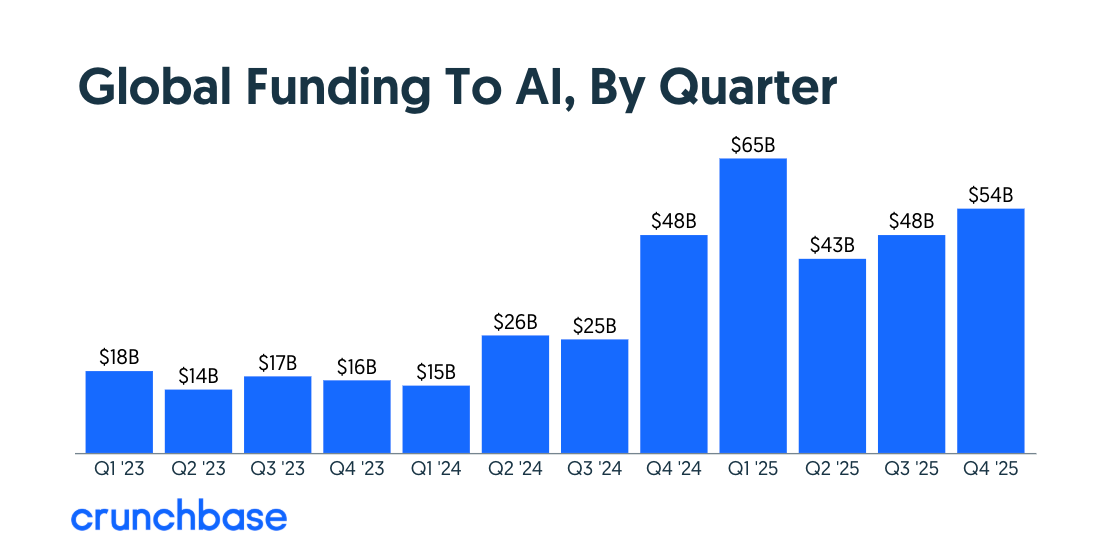
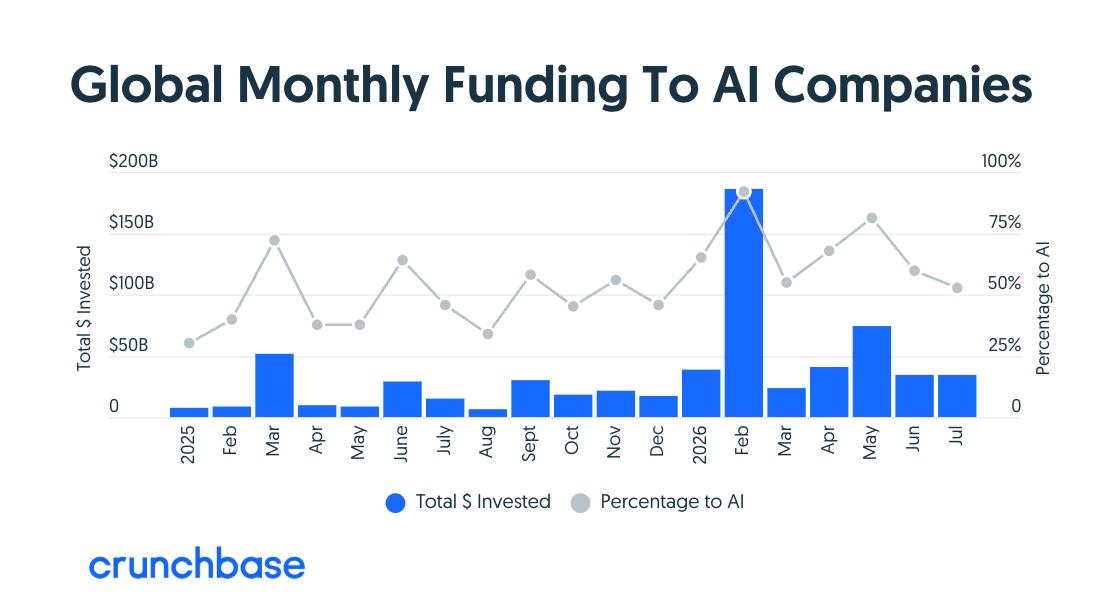
Then 2026 broke every record. Crunchbase counted $300B invested in Q1 2026, up more than 150% both quarter-on-quarter and year-on-year, and the largest venture quarter it has ever recorded.
AI took $242B of that, or 80%, compared with 55% in Q1 2025, which was itself a record at the time. In a single quarter, AI startups raised more than they did in all of 2025. Other trackers confirm the scale, even if their totals differ because they use different datasets and deal definitions. KPMG's Venture Pulse, which is based on PitchBook data, put Q1 2026 at a record $330.9B, more than double the $128.6B invested in Q4 2025.
The pace slowed after that, but only relative to an exceptional start. Q2 2026 was still the second-largest quarter on record, with $227.4B invested across 8,440 deals according to KPMG. The rate moved into the second half: July added another $65B, double July 2025, with 53% going to AI and a record 14 rounds of $1B or more in a single month.
AI's productivity upside is now measurable, and so are its costs for workers and for margins.
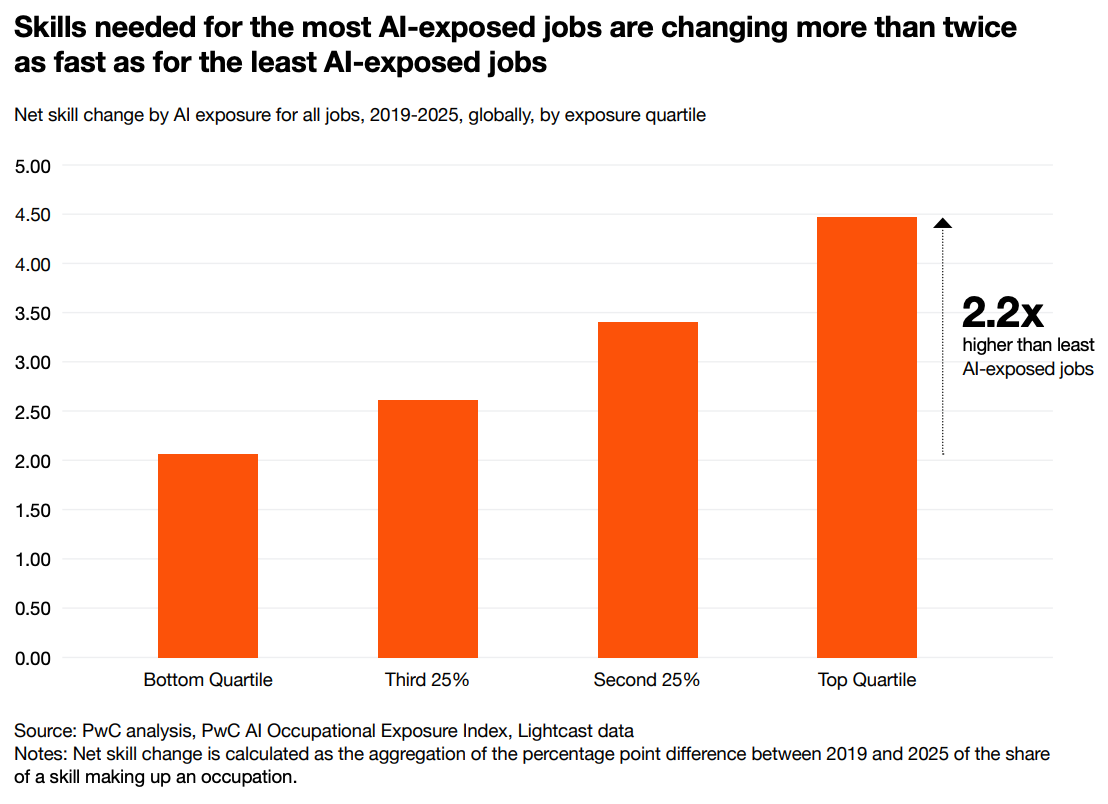
On the upside, companies that use AI well are pulling ahead. PwC's 2026 Global AI Jobs Barometer, built on more than one billion job ads across 27 countries, found that the most AI-exposed companies grew headcount faster than the least exposed (52% vs 36%) and raised wages faster (24% vs 17%). Jobs requiring AI skills grew 69%, against 9% for the overall job market, and the average wage premium for AI skills rose to 62%, up from 57% a year earlier.
For founders, that translates into leaner teams. AI agents now handle support, coding, research, and back-office work that used to require early hires, which lets a seed-stage company stretch its runway and reach revenue with fewer people.
PwC data shows a two-track labor market: AI-exposed entry-level roles now demand more senior skills, while non-AI-exposed entry-level roles have fallen 10% since 2019. Crunchbase counted more than 127,000 workers laid off at US tech companies in 2025, and the cuts have continued into 2026.
There is also a business-model challenge that matters directly to investors. Every query and every agent task consumes compute, so AI companies average gross margins of around 52%, according to ICONIQ, well below the 70-90% typical of mature SaaS.
Bias, privacy, copyright, and safety remain open debates, which is why the regulatory framework covered below matters for every European founder building with AI.
AI became Europe's largest venture sector in 2025, and in 2026 it took a majority of all European deal value for the first time.
European startups raised $58B in 2025, up about 9% year on year, and AI led the way for the first time with around $17.5B, up from just over $10B in 2024, according to Crunchbase.
Dealroom and Prosus, using a broader definition, put European AI funding at a record $21.8B in 2025, up 58% in a single year. Their State of AI in Europe report shows how far the sector has come. AI funding in Europe is now nearly 10x its 2016 level of $2.3B.
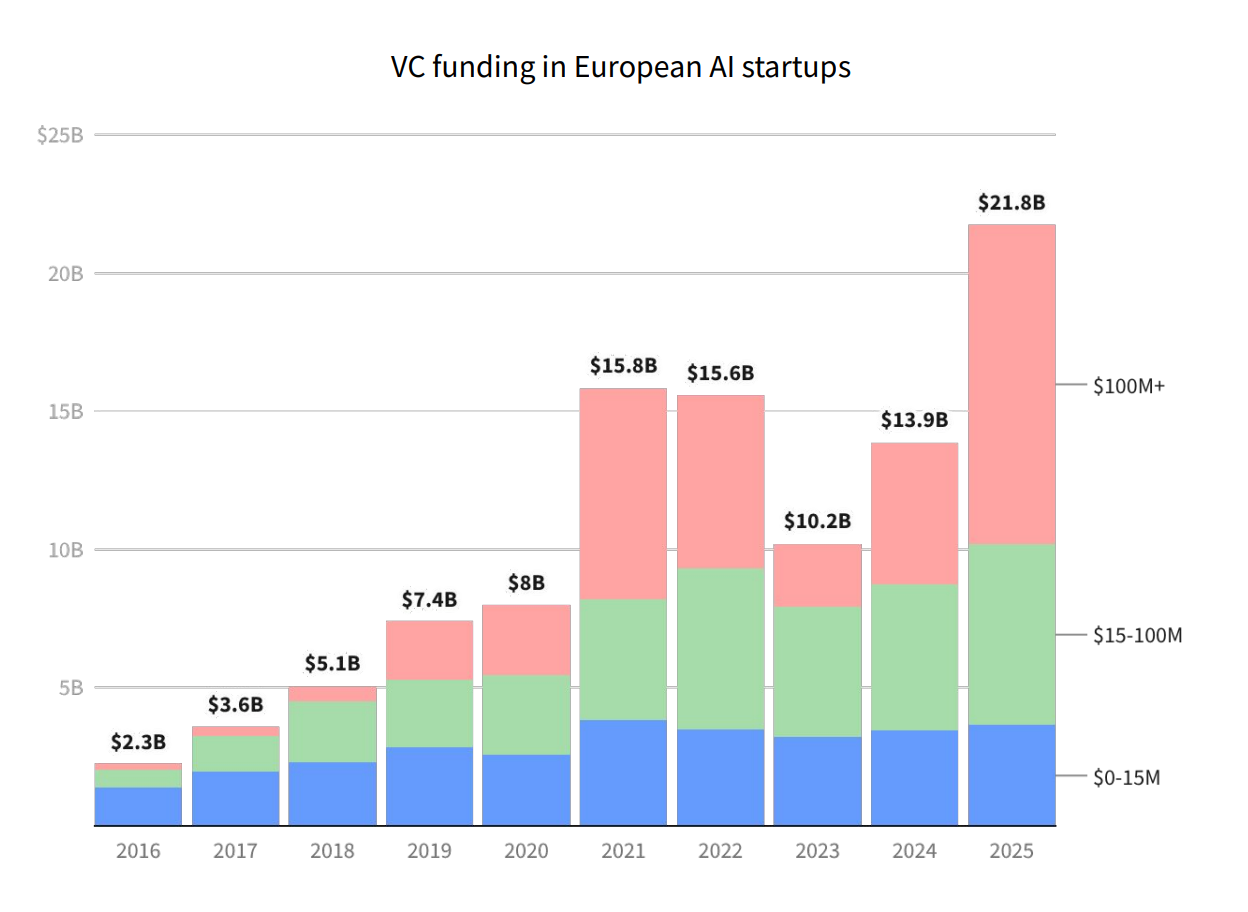
AI is also taking a much bigger share of the European venture market. According to the same report, AI accounted for more than 30% of all European VC funding in 2025, double its share three years earlier. 8/10 largest seed rounds ever raised in Europe went to AI companies, suggesting investors are now willing to back new AI labs with very large first cheques.
The money is going mainly into applied AI rather than general-purpose models. Over 75% of European AI funding targets vertical, specialist applications in health, energy, fintech, security and defense, and legal.
The first half of 2026 changed the scale of European AI. PitchBook's Q2 2026 European Venture Report puts H1 deal value at €44B, with AI deals accounting for 60.2% of it, up from 37.8% in 2025. AI deal value had already reached €26.5B, ahead of the full-year 2025 total.
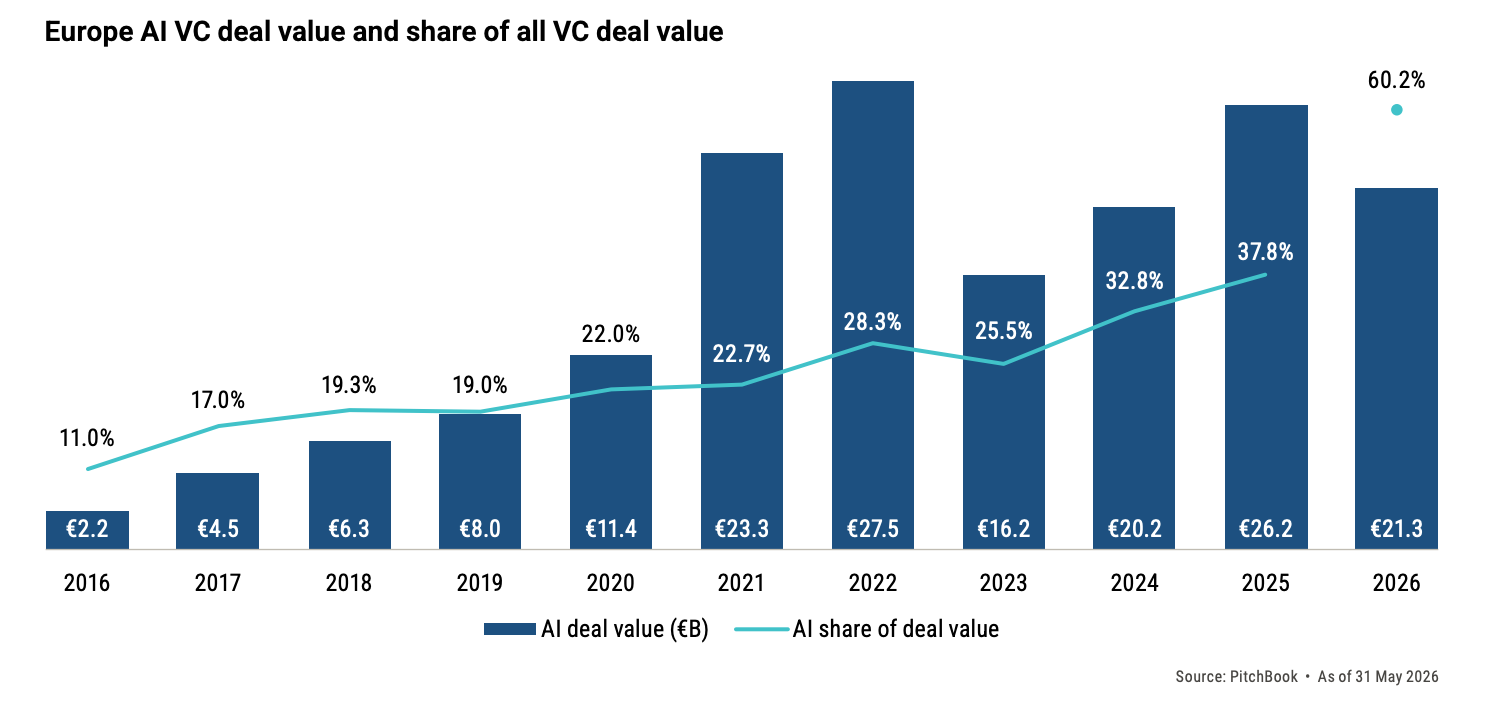
Crunchbase shows the same rate. European funding rose 50% year on year to $42B in H1 2026, and AI-focused companies raised more than $10B in Q2 alone, the largest quarterly amount on record. KPMG counted $25.6B of European VC investment across 1,636 deals in Q2 2026, led by UK AI rounds for Isomorphic Labs (2.1B), Wayve (1.3B), and Ineffable Intelligence ($1.1B).
The flagship European deal of the year came in September: Mistral AI raised a €3B Series D at a post-money valuation of more than €21B, led by Samsung with the EQT-managed Scaleup Europe Fund as co-lead. It is the largest equity round ever raised by a European tech company.
The UK, Germany, and France remain the core hubs, with Sweden and Switzerland close behind. In Q2 2026, the ranking held at the top: the UK raised $10.4B, Germany $3.2B, France $2.4B and Sweden $2B. Sources: Crunchbase, 2025; Crunchbase, Q2 2026.
France has the continent's most valuable AI lab in Mistral, and Paris was Europe's largest deep tech hub in 2025 with $3.0B raised, ahead of London and Munich, according to Dealroom's European Deep Tech Report 2026. The UK leads on AI megarounds (Isomorphic Labs, Wayve, Nscale, Ineffable Intelligence, Recursive), while Germany leads on robotics and defense, with Neura Robotics and Helsing.
The growth is real, but so is the gap. Europe's H1 2026 total of $42B compares with $392B raised in North America over the same period. Mistral has raised about $4B to date, against $186B for OpenAI and $161.25B for Anthropic.
The scaling capital problem persists too. According to Dealroom and Prosus, by the time a European AI company reaches late stage, 73% of its lead investors are American. And capital is concentrating: mega-rounds of €100M or more made up 55.4% of European deal value in H1 2026 while accounting for just 1.8% of deals.
In CEE, AI went from a quarter of venture investment to more than half in a single year.
According to Dealroom's CEE 2025 in review, AI took 52% of CEE VC investment in 2025, up from 23% in 2024, a higher share than Europe's 34%. Deep tech rose from 17% to 37% over the same period.
Overall, CEE startups raised €2.3B in VC in 2025, with a recovery starting in Q4 2025 (€756M) and continuing into Q1 2026 (€952M). The region's combined enterprise value reached an all-time high of €274B in 2026, split between €142B in private and €132B in listed startups.
The data from the same report also points to two defining traits of the region:
That combination is why early-stage AI companies in the region keep attracting international follow-on investors. Romanian-founded Veridion, for example, raised a $20M Series A led by London-based Hoxton Ventures in September 2026 to scale its AI-driven business intelligence platform.
The challenges founders reported in The Recursive's earlier CEE surveys (commercialization, talent and data quality) have not disappeared. But the investor question has changed: regional VCs now look for applied, vertical AI with clear ROI and workflows customers already pay for, rather than thin wrappers on top of a foundation model.
Europe has eased the AI Act's timeline for high-risk systems and launched new public-private capital to keep AI scaleups in the region.
The biggest regulatory change since our last update is the Digital Omnibus on AI. It was published as Regulation (EU) 2026/1744 and entered into force on 27 July 2026, just days before the original high-risk deadline.
Some obligations are already in place. Rules for general-purpose AI model providers have applied since August 2025, and the Omnibus did not touch them. The next milestone is 2 December 2026, the watermarking deadline under the Article 50 transparency rules, which the Omnibus also left unchanged.
The high-risk rules are where the timeline went. Obligations for stand-alone high-risk systems, such as those used in HR, credit scoring, education and biometrics (Annex III), now apply from 2 December 2027, deferred from 2 August 2026. For AI embedded in products already covered by EU product-safety law, the deadline moves to 2 August 2028.
For startups selling into HR, finance, education or healthcare, the extra 16 months is breathing room. Enterprise buyers already ask about risk classification and documentation in procurement, so compliance readiness is becoming part of the sales process.
On the capital side, the EU has moved from strategy papers to money. The €5B Scaleup Europe Fund, managed by EQT, became operational in August 2026 to invest alongside private investors in scaleups in AI, quantum, biotech, and clean tech. It co-led Mistral's €3B Series D within weeks. Policymakers are also targeting pension capital: Dealroom and Prosus estimate that raising European pension funds' venture allocation to 3% would unlock about €100B for growth capital.
Sovereignty is now both a commercial and a political argument. Mistral is building its own data centers and plans up to 1GW of capacity in Europe by 2030, while European enterprise and public-sector buyers increasingly ask where their data and models run.
For the first time, frontier AI will have a daily public price, and that price will shape how Europe values every AI startup.
Until now, a small group of investors set frontier-lab valuations in private rounds. Anthropic raised a $65B Series H at a $965B post-money valuation in May 2026 and confidentially filed for an IPO on 1 June. According to Bloomberg, it now aims to go public as soon as mid-November, with formal marketing starting the week of 9 November, and reportedly targets a valuation of up to $2 trillion, which would make it the largest IPO ever.
OpenAI raised $122B at an $852B valuation in March 2026 and confidentially filed its own S-1 on 8 June, but it is leaning toward a 2027 listing as it holds out for a $1 trillion valuation.
The exit market they enter is already very different from a year ago. Global VC-backed exit value hit $1.9 trillion across 775 exits in Q2 2026 alone, above the previous full-year record of $1.5 trillion set in 2021, driven by SpaceX's record IPO. Crunchbase counted 32 companies going public at values above $1B in Q2.
Early-stage specialists and public-backed funds still write the most European AI cheques, even as US investors dominate the late stage.
As AI continues to reshape industries and drive growth, top VC funds across the continent are stepping up, recognizing the vast potential of innovative startups. Below is a list of the top 10 Europe-based investors in European AI, ranked by the number of AI investments they have made, according to Shizune's investor database (September 2026). Globally, Singapore-headquartered Antler tops the same ranking with 169 European AI investments.
Across all sectors, Bpifrance is Europe's most active startup investor with 1,604 disclosed rounds, followed by Enterprise Ireland with 974, according to Dealroom. And new capital is arriving: European VC fundraising reached €8.2B in H1 2026, ahead of the 2025 pace, according to PitchBook.
If you're the founder of an AI startup looking for the right investors, explore our comprehensive European VC network and our roundup of European VCs that raised fresh funds in Q2 2026.
Here is a snapshot of some of the startups that have successfully raised various fundraising rounds through SeedBlink.
The next 12 months will test whether AI's private valuations hold up in public markets, and European founders who can show durable revenue and healthy unit economics will be best placed whichever way it goes.
For investors eager to back the next wave of AI innovation, keep an eye on SeedBlink's top-tier startups. You'll get early access to promising ventures, a transparent investment process, and the opportunity to diversify your portfolio with cutting-edge technologies.
Are you an AI startup looking for funding? Check out SeedBlink's offerings, from syndicated investments within your network to cap table cleanups, strategic fundraising, and crowdfunding. For a closer look at this year's numbers, read our State of Fundraising in Q2 2026.
Written by

Patricia Borlovan
Communication Specialist
TABLE OF CONTENT

Subscribe to our newsletter
No spam. Just the latest releases and tips, interesting articles, and exclusive interviews in your inbox every week.
Share this article


