
Prepare to raise | CORE
Expert guidance, investor matching, and visibility
Private rounds
Raise from your network with professional infrastructure
Cap table & equity management
All-in-one equity and stakeholder management
ESOP
Incentivize your employees and manage ESOPs seamlessly
Explore SeedBlink Legal

Investments
A conversation between Maria Koletsou and our colleague Bogdan Stoian on how investors price risk at each stage, why later-stage isn’t risk-free, and why liquidity now matters as much as access.
November 17, 2026
·
5
min read
Every startup investment carries risk, whether you write the check at pre-seed or a few months before an IPO. What changes from one stage to the next is not the presence of risk, but how investors price it.
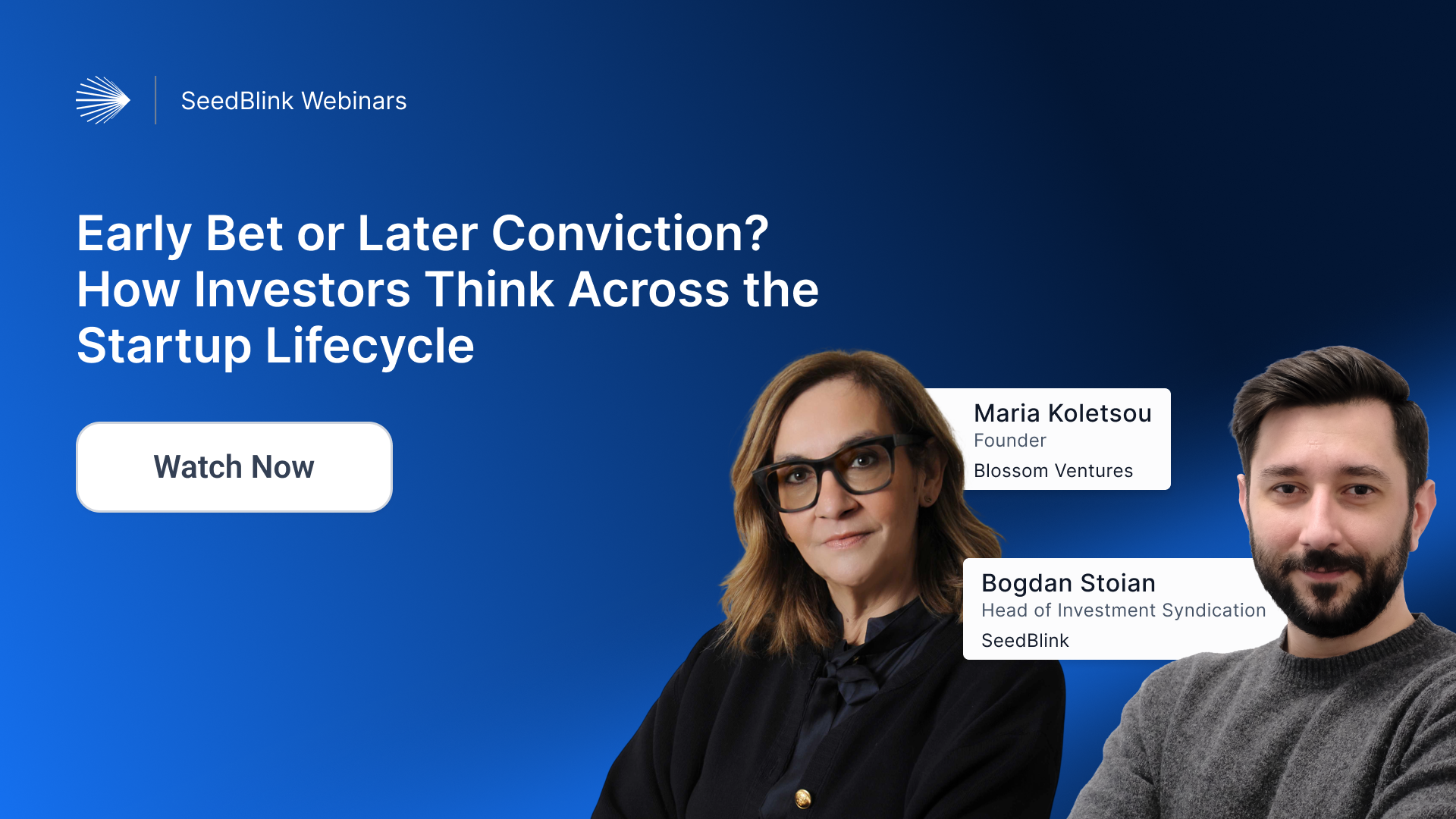
That idea ran through our latest webinar, where Bogdan Stoian, Head of Investment Syndication at SeedBlink, sat down with Maria Koletsou, Founder of Blossom Ventures.
The two brought complementary views to the table. Bogdan has spent six years at SeedBlink watching companies move from pre-MVP to Series B, exits, and failures, and has a view of how thousands of investors behave on the platform. Maria has invested in private markets for almost three decades and now leads a syndicate that invests from pre-seed to pre-IPO, backing founding teams that meet its diversity criteria.
If you followed our earlier conversation with Maria, this webinar builds directly on it. In Part One, she explained why she invests in lines, not dots. In Part Two, she made the case for syndicates that stay with companies across their full lifecycle.
Here are the main takeaways from the webinar, and what they mean for anyone investing through a syndicate.
The conversation opened with a trend Bogdan has seen on the platform over the past 18 to 24 months. More founders are choosing to bootstrap for as long as possible, often until seed or beyond.
In 2023, pre-MVP startups were pitching VCs, family offices, and angel networks everywhere. Today, more of the companies approaching SeedBlink already have a product on the market and revenue coming in.
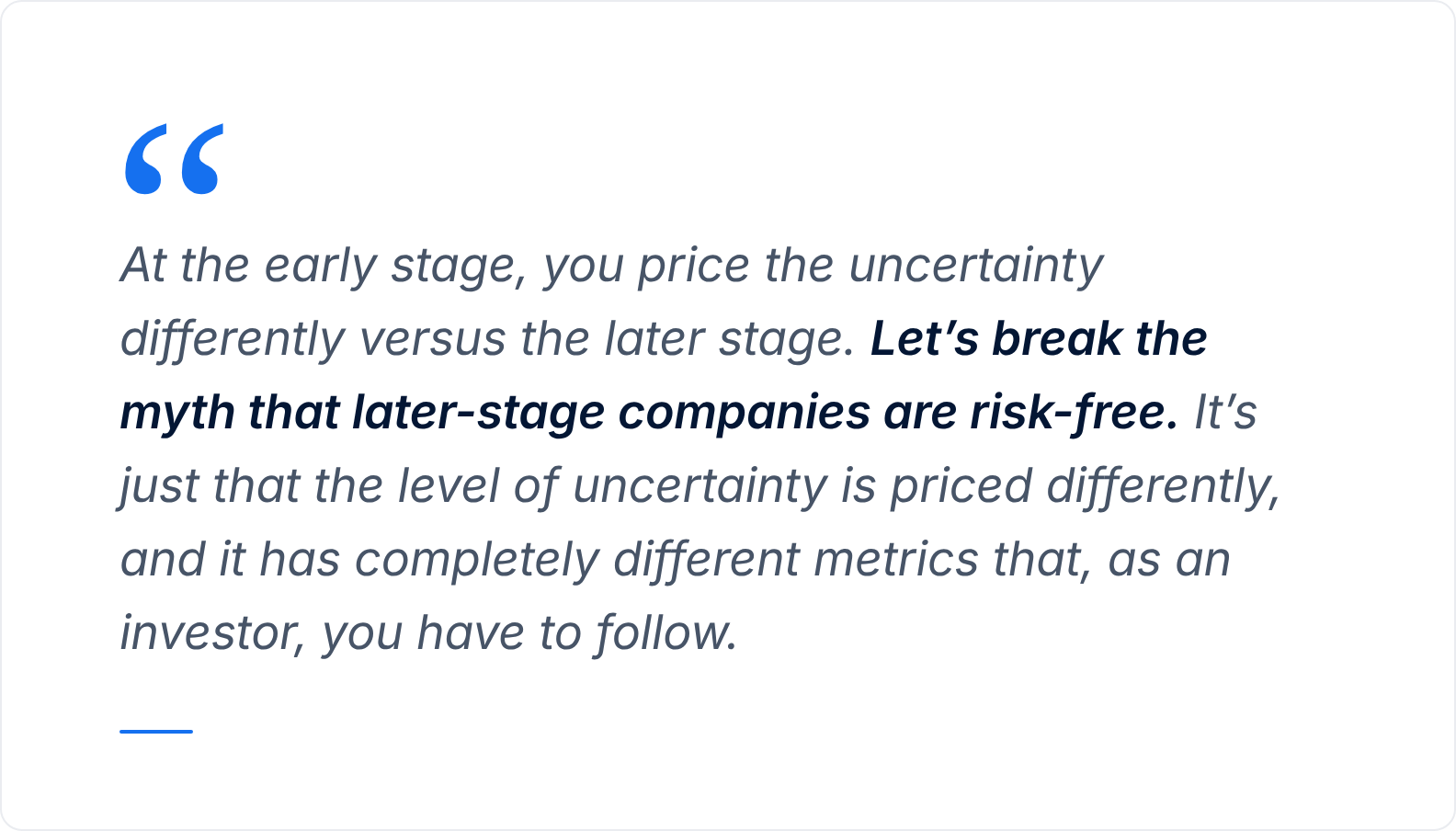
Against that, Maria challenged a common assumption: that later-stage companies are the safe option. In her view, both stages are analyzed through the same lens. The difference lies in how uncertainty is priced.
She also pointed out that the definition of “early stage” itself is moving. AI has dramatically shortened the time it takes a company to go from pre-seed to Series A, which means more competition for capital and for every vertical.
“What we have seen in the last year is basically a tectonic technological shift. What is called pre-seed and seed today might be slightly different from what we called it a year ago. The critical change is speed.”
At pre-seed, there is little data to analyze.
The founding team and the vision are almost the only inputs, so the investor's job is to judge whether these people can deliver what they promise.
“The defining factor at the early stage is the founders. This is the only information we have: a dream. You price the dream, the promised land, and you are called to judge if the founders are able to deliver.”
Two things lower that uncertainty, according to Maria: how fast a team learns and how fast it can pivot. Both are priced in. Consistency matters just as much. She described finding different margins on page two and page nine of the same deck, or numbers that change from one founder newsletter to the next. If those inconsistencies continue after the investment, they become a red flag.
Bogdan added a data point from SeedBlink's investor base. Repeat founders earn investor trust far more easily, even when their previous venture failed.
“Whenever there is a repeat founder, or a founder that tried something before, even though the venture failed, investors look at it completely differently. They are ready to put their trust and their money way more easily into the new idea.”
Both of them also noted that the founder who takes a company to Series A isn’t always the one who takes it further. Bogdan shared how SeedBlink co-founder Radu Georgescu describes the role: every startup is like an hourglass, with the CEO at the narrow middle, responsible for everything below and for the investors and shareholders above.
At the early stage, founders step into every department. By seed and post-seed, investors want a company that relies less on its founder and has teams that can scale the solution consistently, with healthy unit economics.
As companies mature, evidence replaces the dream. Traction, revenue, customer retention, acquisition cost, and unit economics become the core of the analysis, and investors can set a price using multiples, comparables, or DCF models.
Bogdan noted that SeedBlink's investors look in the same direction: at the early stage, they ask about product-market fit and scaling plans, while later they look at metrics and whether a company can expand into several markets at once.
But more data does not mean less risk. Maria used Skype as an example of a company that ticked every box, reached a multi-billion valuation, was acquired, and then disappeared. Today, a large AI provider can internalize a product's core feature overnight.
“The plot becomes more interesting, not necessarily safer. Safer is relative to whatever else is happening in the sector, in the world, and within the company.”
She shared three questions she uses to test a later-stage deal:
Bogdan confirmed that the ability to raise the next round weighs more heavily for later-stage investors, because that is how they expect to reach liquidity. Maria added that some late-stage companies now avoid dilution altogether through revenue-backed, mezzanine-style financing.
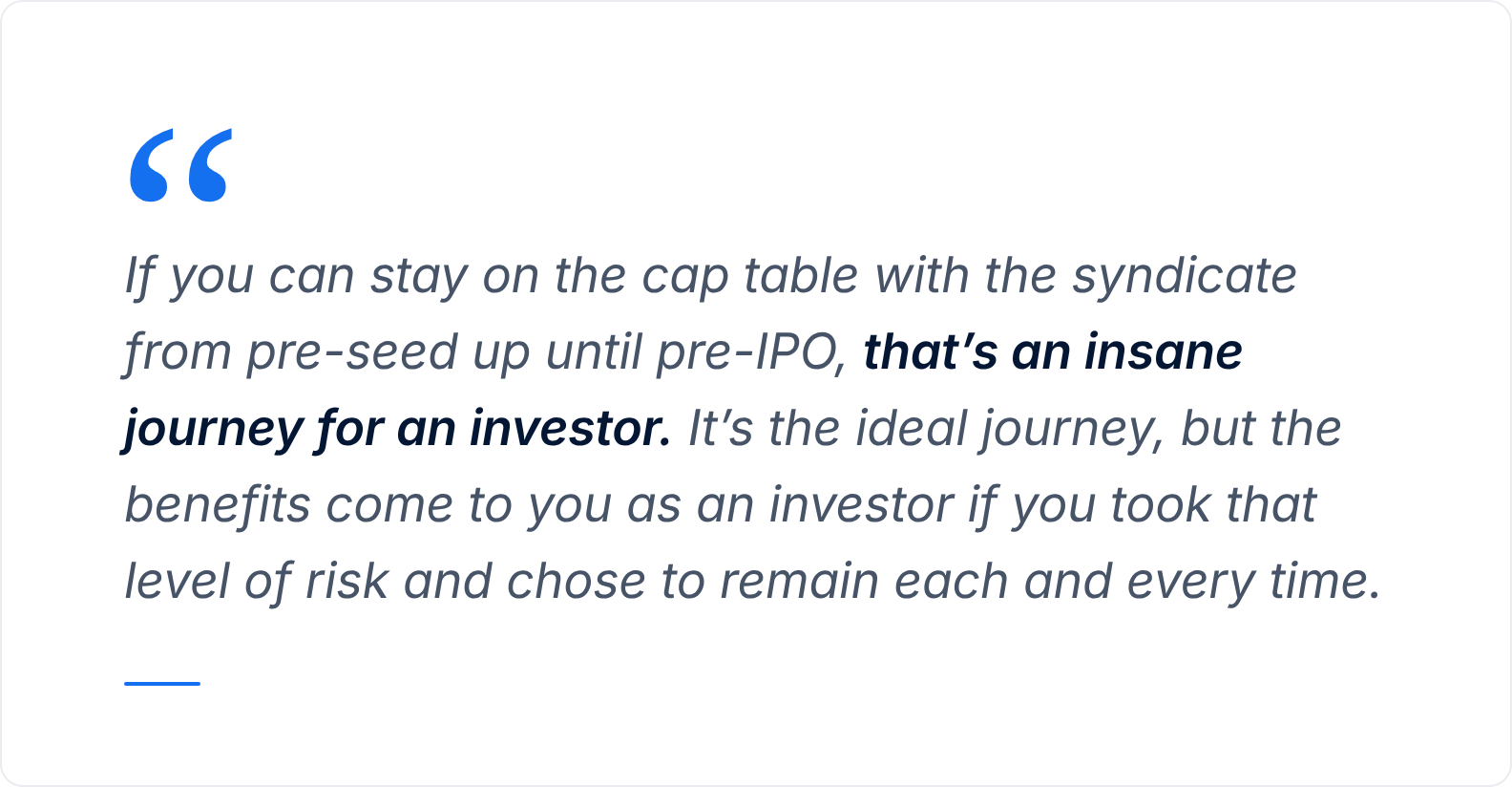
One idea Maria returned to, and one she first explained in Part One of our interview, is that a single snapshot of a company tells you very little. The signal is in the trajectory.
“Investing in dots, in snapshots, is difficult. You need to invest in a line, and what that means is that you follow companies. Even if you don't invest on day one, you might invest on day ten.”
In practice, that means expecting regular updates and staying in touch with companies, including the ones you passed on. Maria recommended this as a learning tool: track the companies you said yes and no to, quarter after quarter, and use them to test your own decision process.
Bogdan shared what following the line looks like from SeedBlink's side.
A health tech company raised through a syndicate on the platform in 2023. Three years later, it received full clearance to produce the patented device it had pitched. The founder asked to share the news with investors himself.
“People writing in caps, ‘congratulations, let's do this.’ Three years is quite a long time just to get those approvals, and seeing them that excited, it made my day as well.”
Maria quickly put the excitement in perspective. Good news is welcome, but what truly makes an investor happy is an exit, or getting closer to one.
“My best investment is only the investment that gave me an exit.”
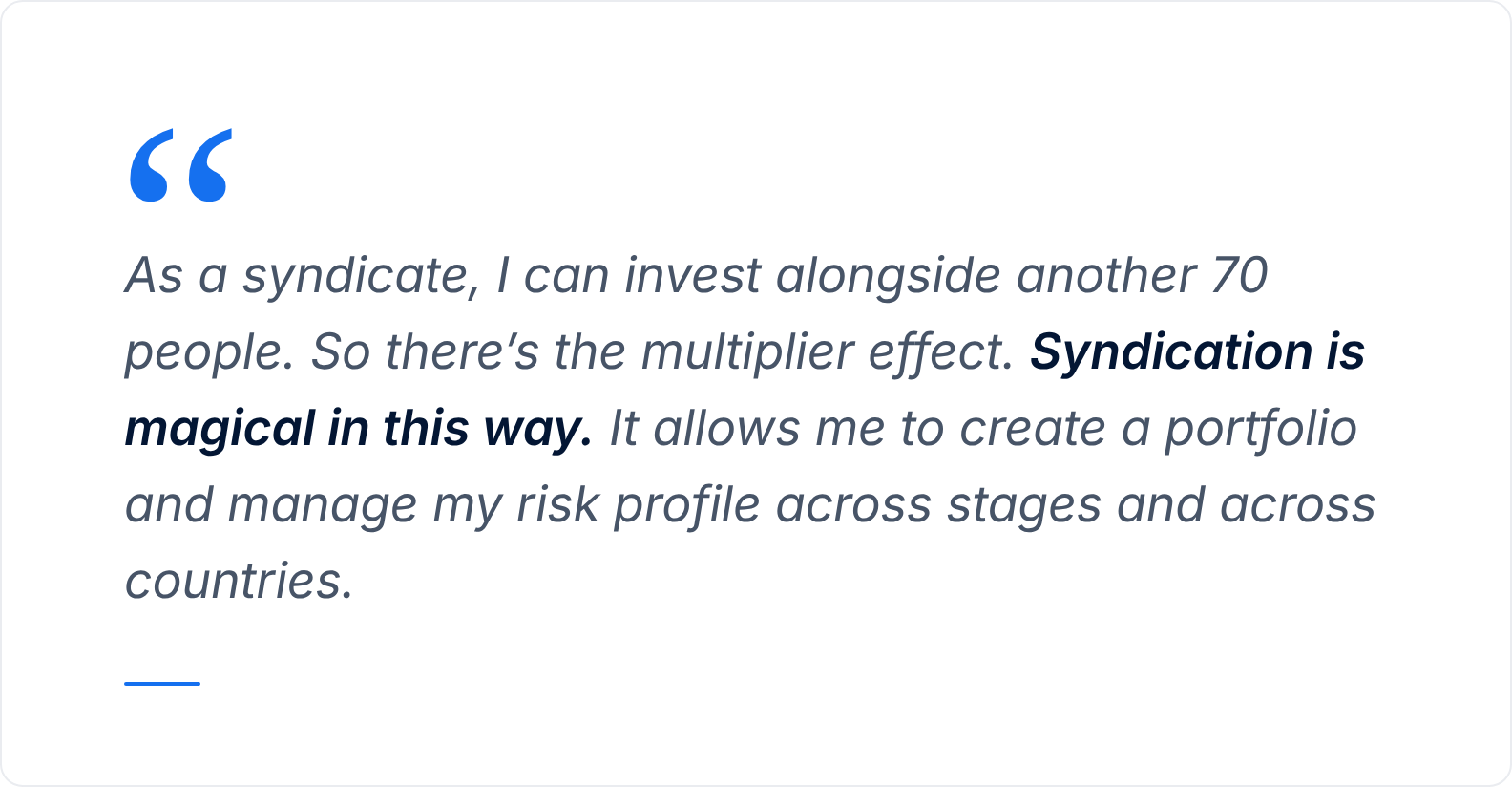
Until recently, investors worked in silos: you were either a pre-seed investor or a later-stage one. Maria believes that is changing as private markets become more accessible, and that syndication is one of the main tools that lets investors cover pre-seed and pre-IPO at the same time.
She illustrated it with simple math. An angel with a €10,000 yearly budget for private markets could back five deals at €2,000 each. Inside a syndicate, the same investor writes a ticket alongside dozens of others.
Bogdan has seen this logic play out in how investors using syndicates on SeedBlink build their portfolios. Through a syndicate, someone made its first two or three investments of the year in early-stage companies with repeat founders. Then a member proposed a pre-IPO deal to balance the portfolio.
When Bogdan asked why they skipped the middle stages, the syndicate shared its reasoning, based mostly on European data: more early-stage companies reach Series A than Series A companies reach IPO. Getting from pre-seed to Series A, and possibly exiting at Series A or B, can already bring a good return. Pairing that with pre-IPO exposure covers both ends.
Ticket sizes also differ by stage.
Bogdan noted that joining a Series A or Series B round usually requires a larger ticket, and that the risk itself changes in nature: early on, the question is whether the founder can execute; later, it is whether the product can break into new markets and beat the competition.
A syndicate brings together many investor profiles, so every member ultimately decides for themselves what fits their portfolio. In practice, experienced investors tend to lead. For Maria, leading means putting your own money behind the deals you bring.
“When I bring a deal and suggest it to the syndicate, it goes without saying that I'm also putting my money in this deal. That's what, in my mind, leading a syndicate actually means.”
Her goal is for more members to bring their own deals with conviction over the next one to two years, so aspiring angels become educated angels who, in turn, educate newcomers. She also warned about the gap between investing money and investing time.
Members who skip their own analysis tend to follow the trend rather than their judgment, and that gap creates mispricing.
Collaboration between syndicates came up as one of the biggest changes in the market. Blossom Ventures has co-invested with other syndicates, sometimes leading with conviction and sometimes relying on a partner's memo and due diligence, for example with UK partners on UK-based companies.
A shared SPV makes this possible with transparency on legal documents and follow-ups. Bogdan added that AI has made matching investors with syndicates far more accurate. A French investor can now join a Greek or Romanian syndicate if the thesis fits, instead of syndicating only with people nearby.
The final piece is liquidity.
Maria is a strong believer in secondaries as a way to offer exits to angels, syndicates, and LPs, and pointed out that a syndicate can sell a position more easily than an individual. She described a market that has grown well beyond simple share transfers.
“Secondaries is not just a simple transaction anymore. There are structured liquidity products; there are collateralized obligations. Liquidity is such a great need and cannot rely solely on IPOs. It's become a product by itself.”
Bogdan shared a related observation from SeedBlink: companies that first raised through a syndicate and later opened up on the secondary market found that investors were far more drawn to the fundraise than to the secondary offer, even though the price had not changed.
Asked what she would tell someone considering their first syndicate, Maria started with education and learning by doing. Join a couple of syndicates, talk to experienced angels, and meet founders. Theory helps, but you only find out who you are as an investor when you write the check.
“After three decades, something I've learned is that we always pay for certainty we don't have, and sometimes we ignore the evidence which is in front of us. Trust your gut, on top of the education.”
She closed with a reminder that the portfolio matters more than any single deal.
“We're living in a time where whatever is in the S&P 500 in five years is being created now. Be part of the change. We all make mistakes. There's no perfect investment and no perfect timing. What you want is the total, the portfolio.”
If you want to learn more about how investors think across the startup lifecycle, watch the whole webinar below:
Blossom Ventures is a European angel investing syndicate that provides members with access to private market opportunities across the full company lifecycle, from pre-seed startups to pre-IPO and secondary investments.
Alongside its investment platform, Blossom Ventures operates the Blossom Ventures Digital Academy, which educates and empowers the next generation of angel investors while supporting diverse founders across Europe. You can join the Blossom Ventures Digital Academy by using SEEDBLINK at checkout for a €100 discount, available until December 26, 2026.
Connect with Maria on LinkedIn
Bogdan Stoian is Head of Investment Syndication at SeedBlink, where he has spent six years supporting investors and syndicate leads through every stage of the investment journey, from pre-MVP rounds to exits.
Want to talk through syndicate investing or set up your own syndicate?
As this conversation showed, syndicates let investors spread risk across stages and countries, collaborate with other leads, and stay with their best companies all the way to liquidity.
SeedBlink provides the infrastructure to make that possible, with professional tools for deal execution, compliance, portfolio management, cross-border investing, and secondary transactions.
Written by

Patricia Borlovan
Communication Specialist
TABLE OF CONTENT

Subscribe to our newsletter
No spam. Just the latest releases and tips, interesting articles, and exclusive interviews in your inbox every week.
Share this article
The latest news, technologies, and resources from our team.


