Prepare to raise | CORE
Expert guidance, investor matching, and visibility
Private rounds
Raise from your network with professional infrastructure
Cap table & equity management
All-in-one equity and stakeholder management
ESOP
Incentivize your employees and manage ESOPs seamlessly
Explore SeedBlink Legal

Fundraising
Discover the latest fundraising insights in European venture that influenced the second quarter of this year.
August 10, 2026
·
5
min read
%20-%20Q1%202026%20-v2.2%20(1).png)
European venture capital entered the second quarter of 2026 with fresh forces. Funding volumes continued to climb, driven by record AI investment and an increase in mega-rounds, while overall deal activity remained subdued.
Investors are deploying larger checks into a smaller number of companies, creating a market where startups can still raise significant capital, but competition for funding has become more intense.
Today, we break down the latest data from Crunchbase, PitchBook, and KPMG to examine how fundraising, deal activity, investor behavior, and sector trends evolved across Europe during Q2 2026. Whether you're preparing for a seed round or planning a later-stage raise, these insights offer a clearer picture of where capital is going and what founders should expect in the months ahead.
The story of Q2 2026 is really a story of divergence: capital and deal count are moving in opposite directions, and that gap is widening. Overall deal volume fell 13% quarter over quarter and 29% year over year (seed-stage figures typically get revised upward as Crunchbase's data set catches up, so the true decline may be softer than it looks).
But the composition of that decline matters more than the headline number, as seed drove most of it, early-stage activity only dipped slightly, and late-stage deal count actually ticked up. In other words, the market isn't contracting evenly; it's hollowing out at the bottom while staying resilient at the top.
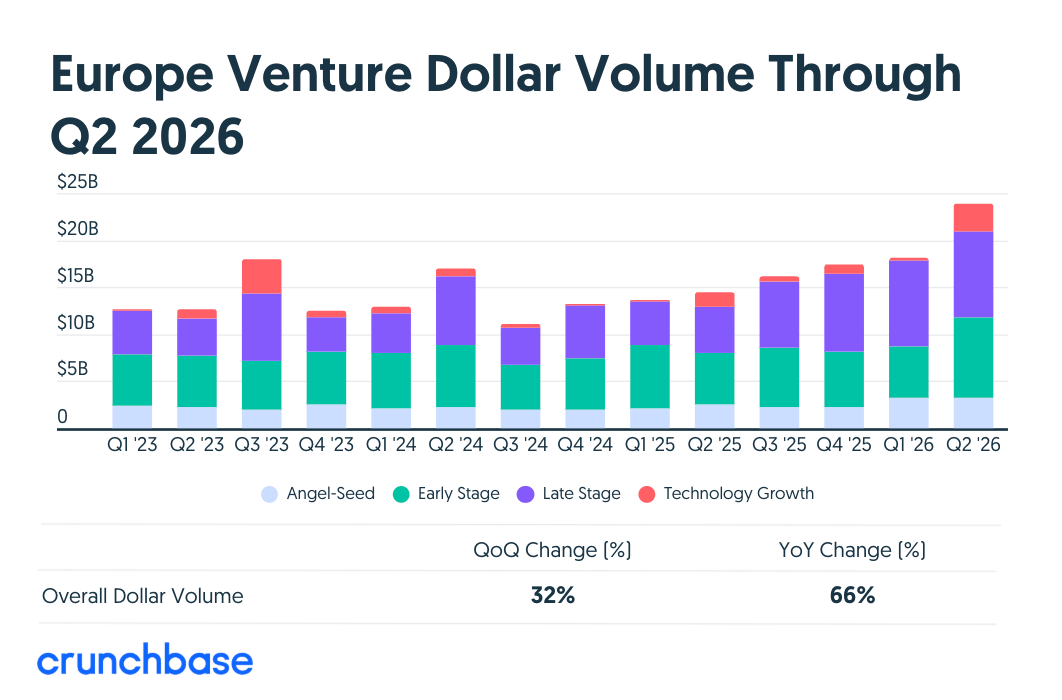
Despite the drop in deal count, overall funding remained strong. Funding to Europe-based startups reached $42B in H1 2026, up 50% year over year, according to Crunchbase.
Still, the region's investment for the first half of the year remained well below the 2021 H1 peak of $60B, and it's drastically lower than the $392B raised in North America's record-setting H1, where funding was up 158% year over year.
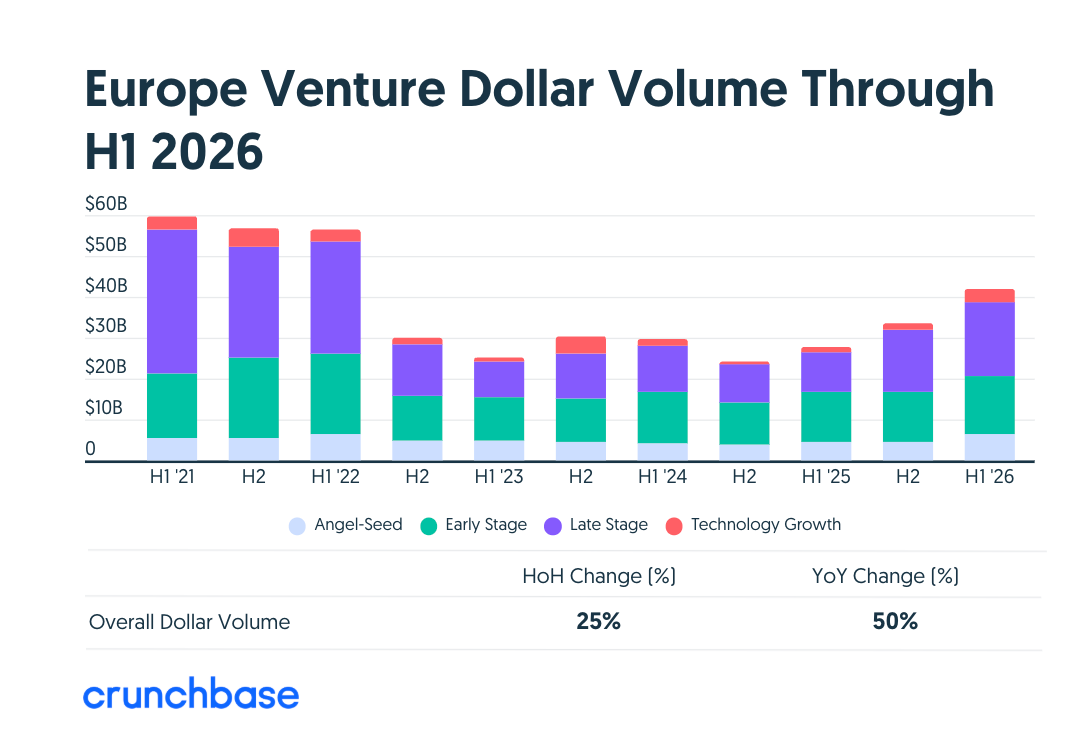
Large rounds continued to drive most of the gains. According to Crunchbase, four companies raised $1B or more last quarter, accounting for 25% of all startup investment in the region. However, most of the year-over-year and quarter-over-quarter growth came from rounds of $100M and over.
The majority of funding, 65%, went to a group of 42 companies that raised rounds of $100M-plus, in sectors including biotech, quantum, financial services, AI labs, aerospace, semiconductors, robotics, and energy.
KPMG data confirms the same trend from a different angle. Total VC investment in Europe reached $25.6B across 1,636 deals in Q2, the second-highest quarterly total in the past four years, down only slightly from the $25.95B recorded in Q1. The number of VC deals remained at historically low levels as investors continued focusing on larger bets on a smaller number of startups.
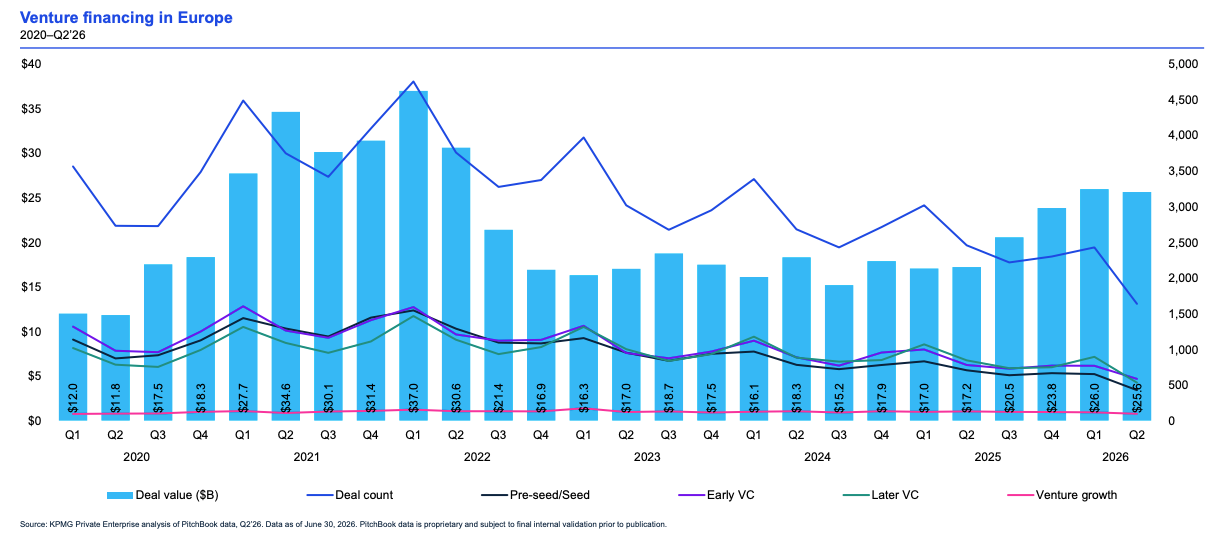
Pricing strength also continued across nearly all funding stages, with down rounds staying subdued. Median deal sizes rose further from Q1 levels, with venture growth rounds reaching $15.3M, later VC climbing to $5.0M, and early VC and pre-seed/seed both landing around $2M to $2.3M.
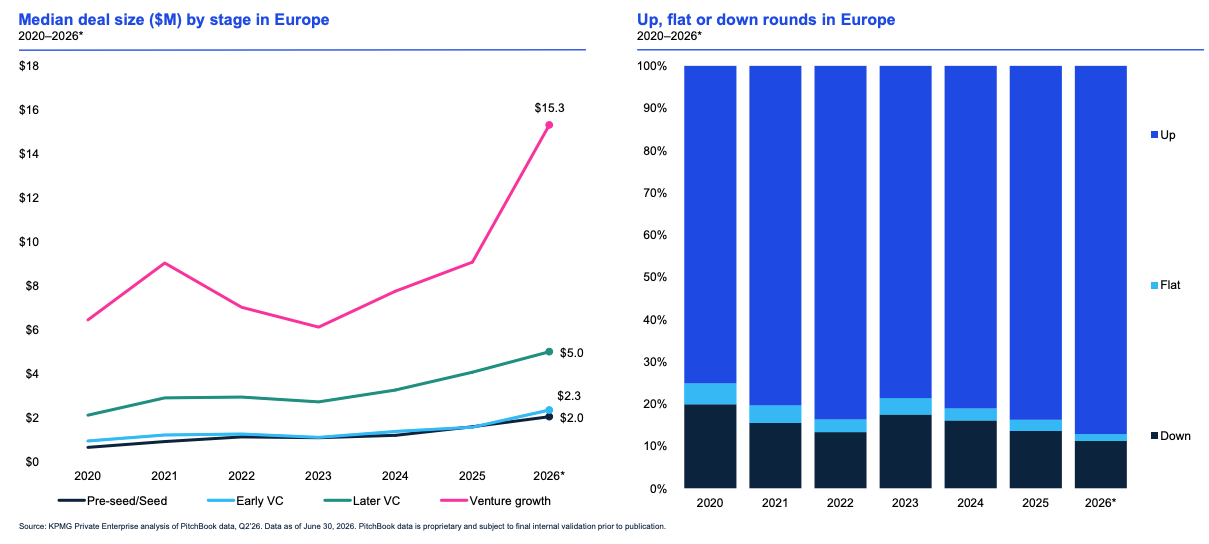
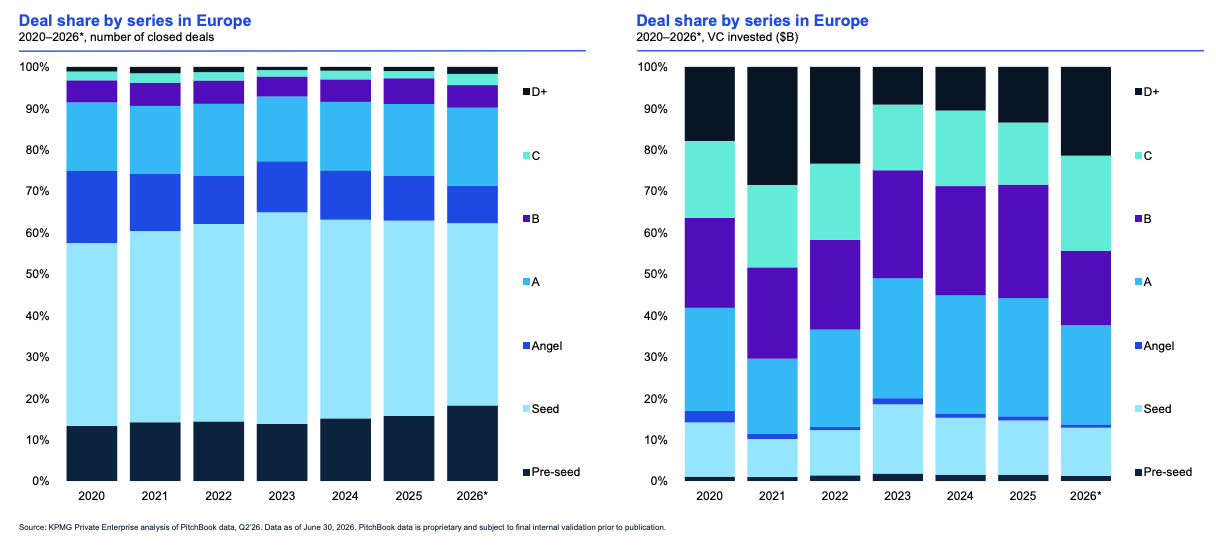
The market also remains split between the earliest and latest stages, continuing the pattern seen in Q1. By number of deals, pre-seed and seed rounds still account for the majority of transactions, showing that startup formation remains active. By dollars invested, however, later-stage rounds such as Series B, C, and D+ continue to capture a much larger share of total capital.
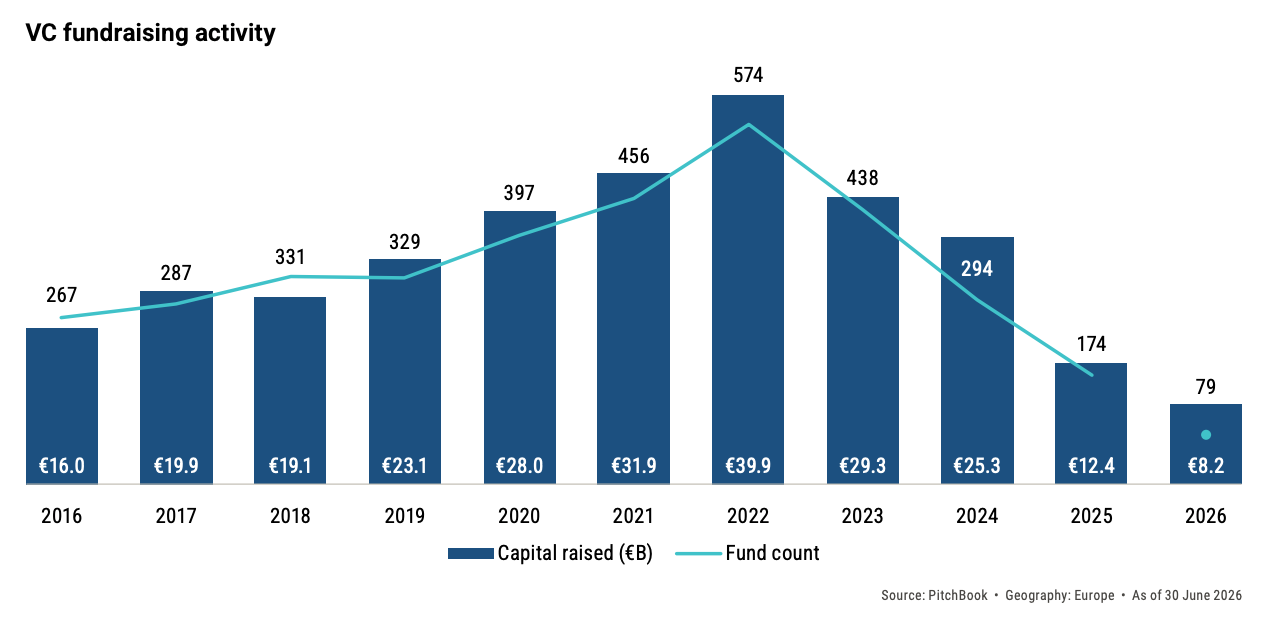
Following a record low in VC fundraising in 2025, fund-of-funds activity remained robust through Q2, with capital raised in H1 2026 totaling €8.2B across 79 vehicles, according to PitchBook. The run rate of activity so far this year is already ahead of 2025, suggesting that fundraising on the continent could grow after years of continuous decline.
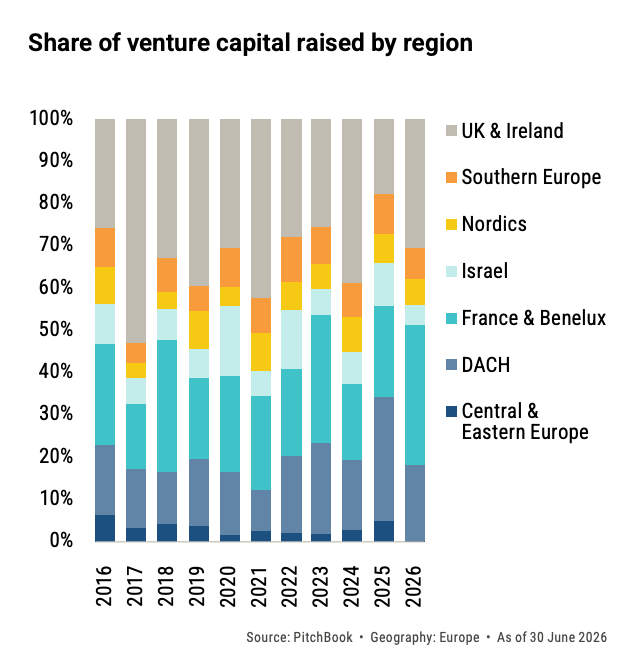
By region, capital-raising trends returned to more conventional dynamics in H1, with France & Benelux holding the lion's share at 33.1% of fundraising, followed by a similar proportion from the UK & Ireland. DACH, last year's regional leader, now lags other core regions with 17.9%. Among the top 10 fund closes, five vehicles were Paris-based, with two each in the UK and DACH.
US investor presence in Europe also continues to grow, and is critical to funding the step-up in round sizes being supported on the continent by both US and nontraditional capital. The number of US investors active in Europe now equals the total number of UK investors, with roughly 1,600 investors in each country participating in VC deals in H1, highlighting the growing prevalence of US GPs in European rounds since 2023.
For a closer look at where momentum is building, read our recent article covering the venture funds raised in Europe during the second quarter of 2026.
European VC deal activity kept accelerating in the first half of 2026, with headline deal value reaching €44B, according to PitchBook. That pace implies a 27.1% year-over-year increase if it holds for the rest of the year, a run rate that's already outpacing the firm's own midyear outlook, which had anticipated at least a 50% increase in AI activity by year-end.
AI remains the central driver behind these numbers. AI-related deals now account for 60.2% of total deal value, up from 37.8% in 2025, an unprecedented level of AI penetration in the European market.
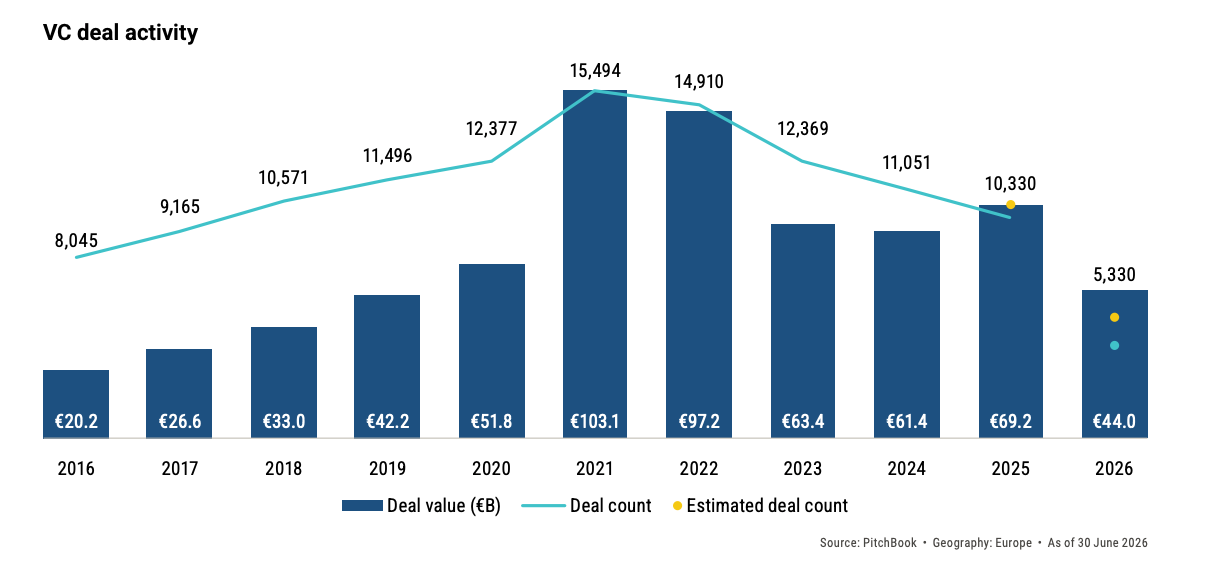
Investment is tracking ahead of that estimate, as competition for capital and startups remains fierce and Europe continues to look relatively underpenetrated compared with the US. By stage, pre-seed and seed rounds have gained the most share of capital in Europe so far this year, as significant deal-value inflation has hit the earliest part of the funnel.
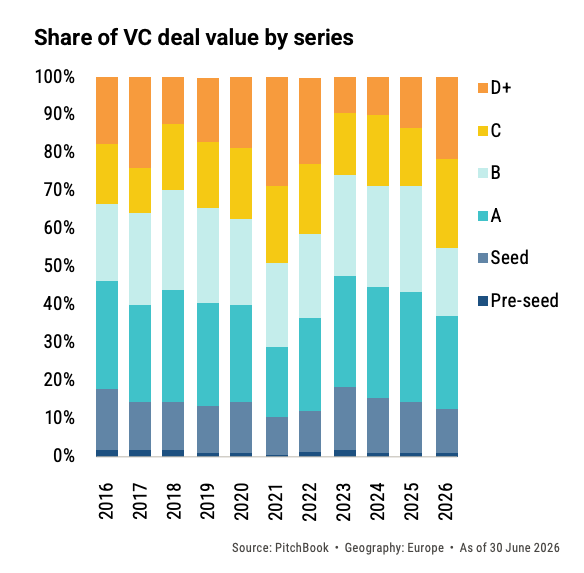
Overall, mega-rounds of €100 million-plus now account for a striking 55.4% of total deal value so far this year, despite representing just 1.8% of deal volume, reinforcing the same barbell pattern seen across fundraising and regional data: a small number of outsized deals are doing an outsized share of the work.
The United Kingdom expanded its venture-funding lead in Q2, as UK-based startups raised $10.4B, not far from the 2021 peak of $10.8B. Germany remained Europe's No. 2 startup market, with $3.2B raised by its startups, while France followed in third place with $2.4B. Sweden was the region's fourth-largest startup market last quarter, with its companies raising $2B.
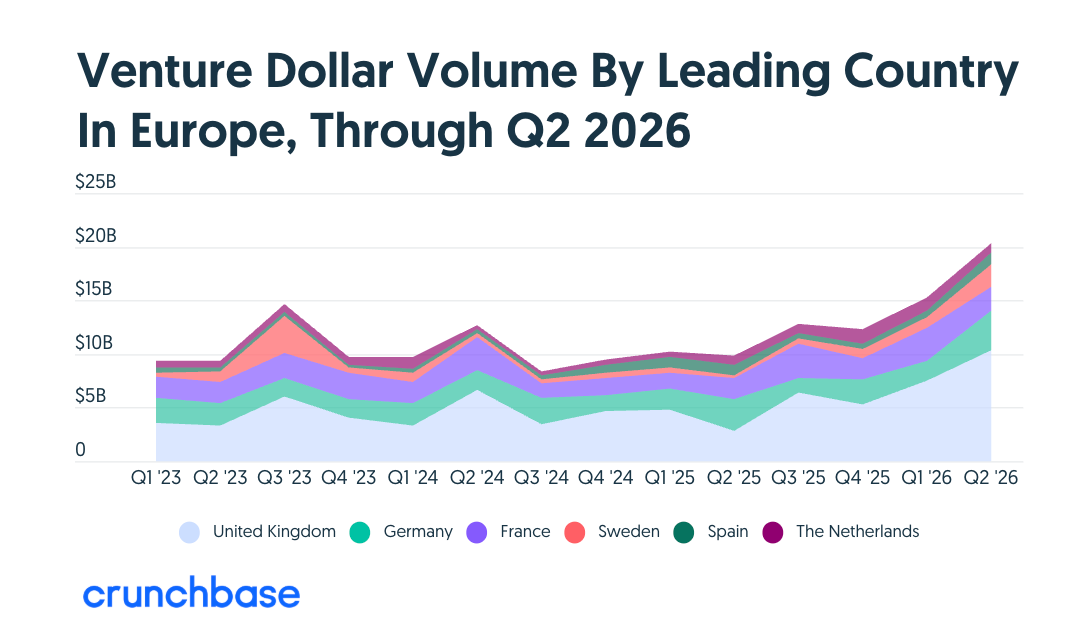
Funding to Europe's AI-focused companies reached more than $10B in Q2, the largest quarterly amount so far, though slightly below the Q1 share, when those companies raised more than half of the region's startup investment. UK-based AI companies attracted the largest deals of the quarter.
VC activity in the Nordics continued its strong momentum in Q2, reaching $4.6 billion across 213 deals, the region's strongest quarter since Q1 2021. PitchBook data shows this jump was once again driven by a handful of mega-deals rather than broad-based growth, a pattern that has repeated through much of the region's recent history: deal count has stayed relatively flat even as deal value has swung sharply from quarter to quarter.
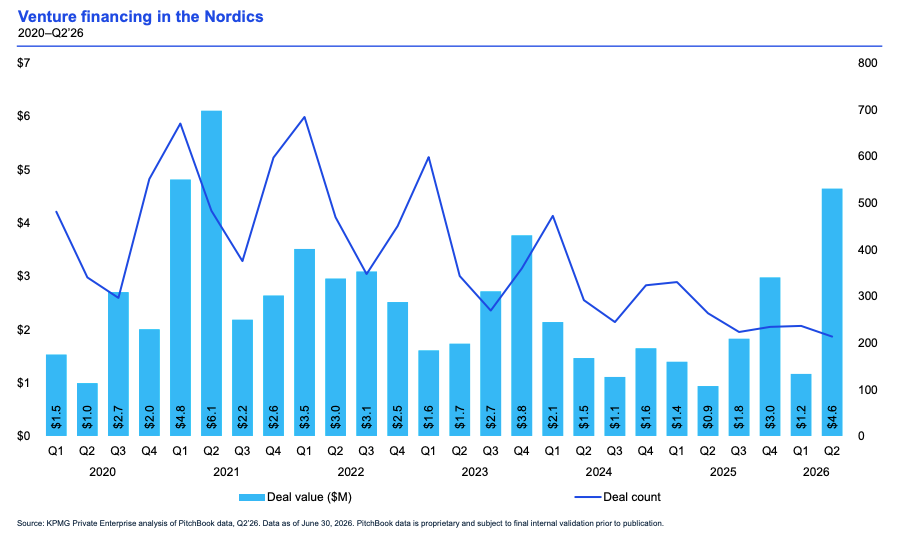
Deeptech also continued to gain attention across the region, although some startups have found it challenging to navigate later-stage funding routes.
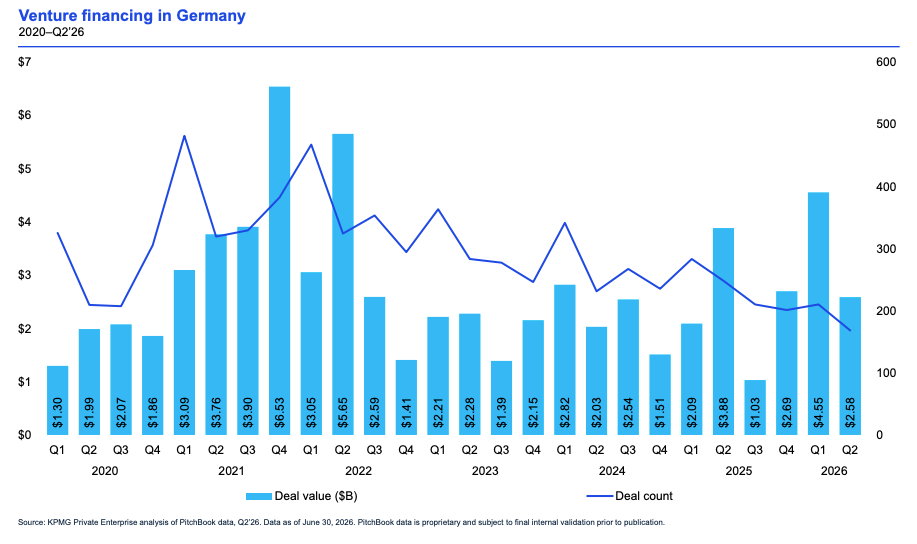
Germany's VC market activity remained steady in Q2 despite a decline in funding. After reaching a 15-quarter high in Q1, VC investment in Germany fell in Q2, though it remained quite steady compared to historical norms. Investors continued to show strong interest in defensetech, AI, and alternative energy.
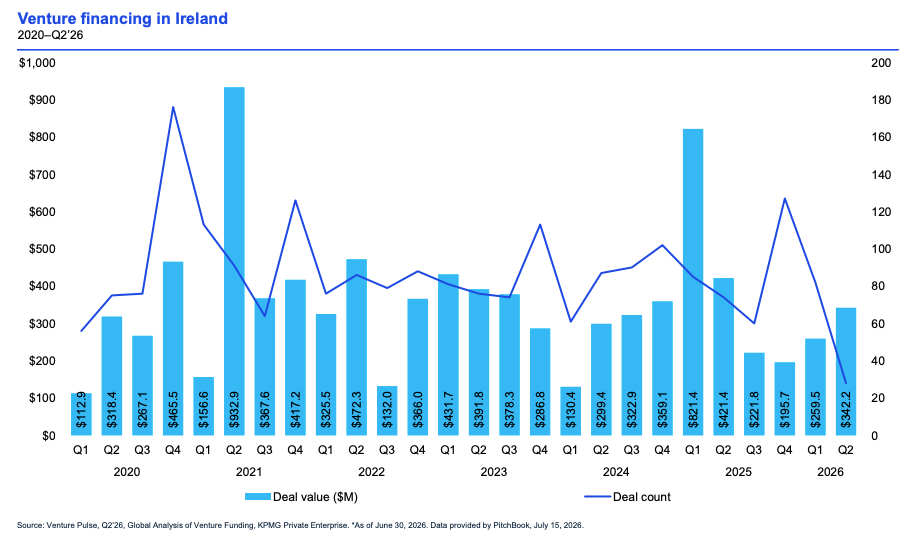
Ireland, meanwhile, continued to see VC investors focus on profitability. Investment there stayed consistent with levels seen in recent quarters, with investors continuing to focus on startups with clear paths to profitability rather than the frontier AI labs driving mega-rounds elsewhere in the region. This has led to a prevalence of relatively small raises compared to what's been seen in the AI sector globally.
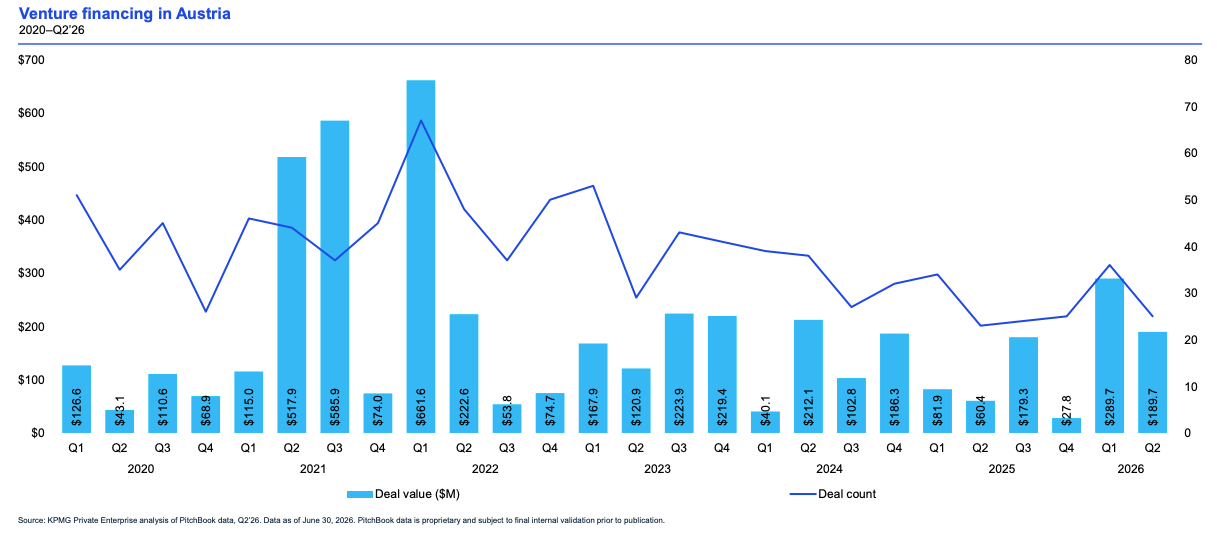
Another thing worth mentioning is that Austria had a healthy second quarter, with $189.7M raised, its strongest Q2 in three years and a continuation of the rebound that began in Q1, when the country raised $289.7M. While still a fraction of the capital flowing into the UK or DACH, the steadier deal count over the past two quarters suggests renewed investor interest in the smaller market.
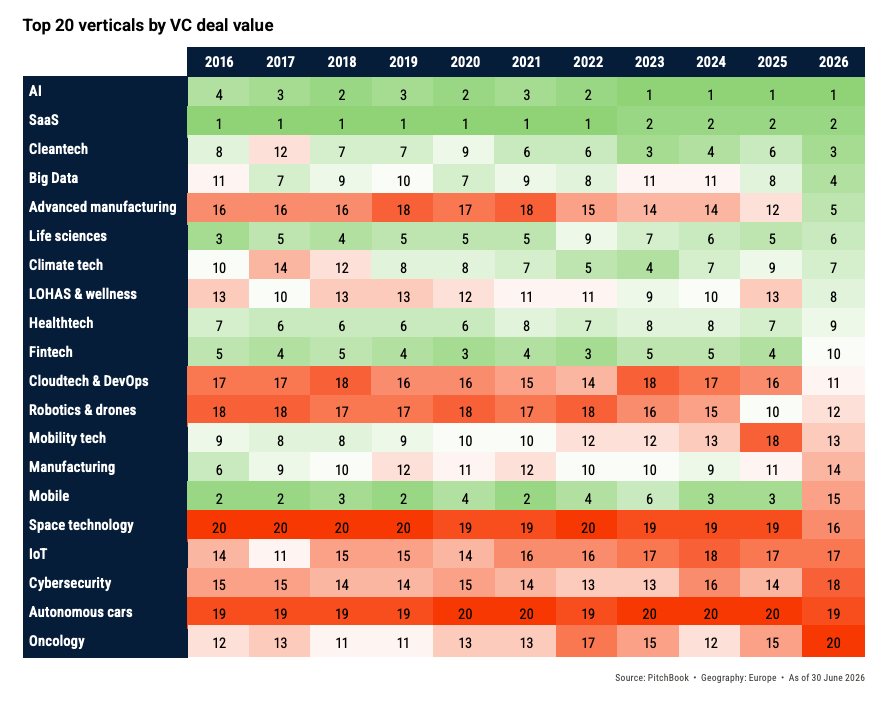
AI held onto the top spot among European verticals by deal value in 2026, and did so by a wider margin than ever. In absolute terms, the surge in AI investment this year has already amounted to €26.5B, ahead of full-year 2025 levels.
If the current activity run rate continues through the rest of the year, AI deal value would therefore double what it was last year, underscoring just how much investor attention has concentrated on the sector.
Early-stage funding in Europe bounced back in Q2 2026, reaching $8.6B across more than 250 startups, according to Crunchbase. Investors appear more comfortable writing bigger checks again, even if they're still picking their spots carefully.
Crunchbase data also confirms the same trend from a different angle. Funding to Europe's AI-focused companies reached more than $10B in Q2, the largest quarterly amount so far, though slightly below Q1's share, when those companies raised more than half of the region's total startup investment.
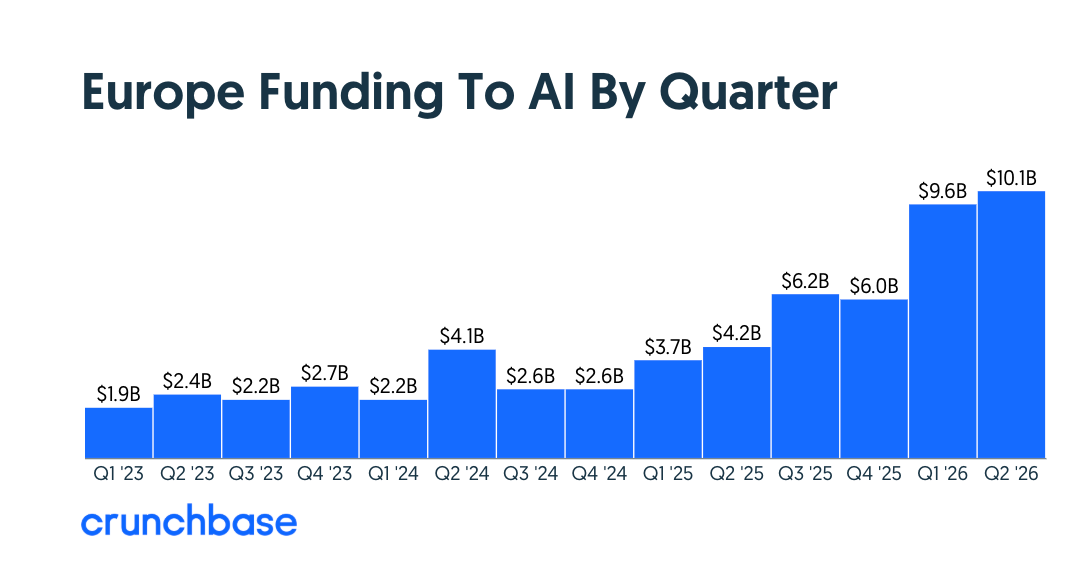
SaaS held onto second place, as it has for nearly every year on record, remaining the steady backbone of Europe's venture ecosystem even as AI pulls further ahead at the top.
Zooming out to the sector level, software as a whole has been pushed to record proportions of the market: software now represents the largest single share of both deal count and dollars invested across Europe, a share that has only grown as AI-native companies get bucketed into the category alongside traditional SaaS.
The bigger story of Q2, according to Pitchbook, though, is who's climbing into third: cleantech has moved up the rankings to now sit in third place among verticals by deal value, outpacing last year's activity with €7.4B invested in H1 2026, a 59.1% increase year over year.
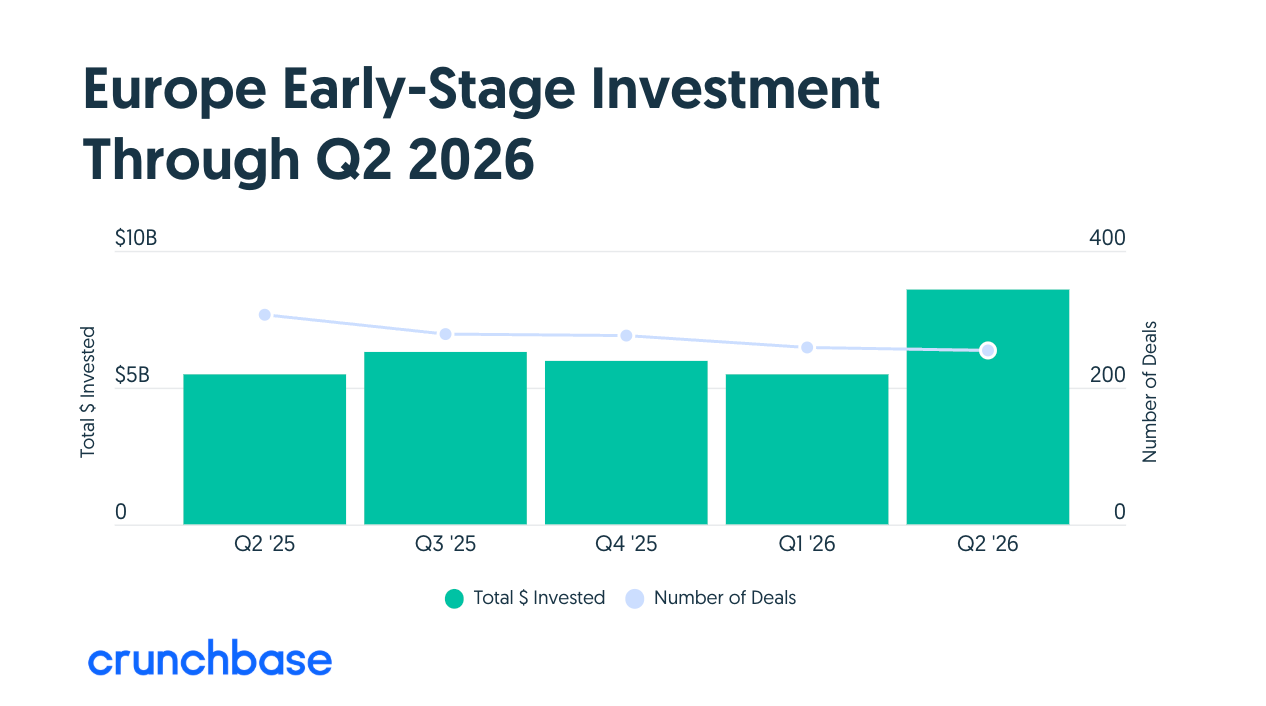
Some of the quarter's biggest Series A and B rounds went to London-based Isomorphic Labs, AI self-learning lab Recursive (also London), Germany's Focused Energy in fusion, London-based chip developer Fractile, and quantum processor maker QuantWare, also based in London. Between AI, energy, and deep tech, it's clear investors haven't narrowed their focus to just one theme.
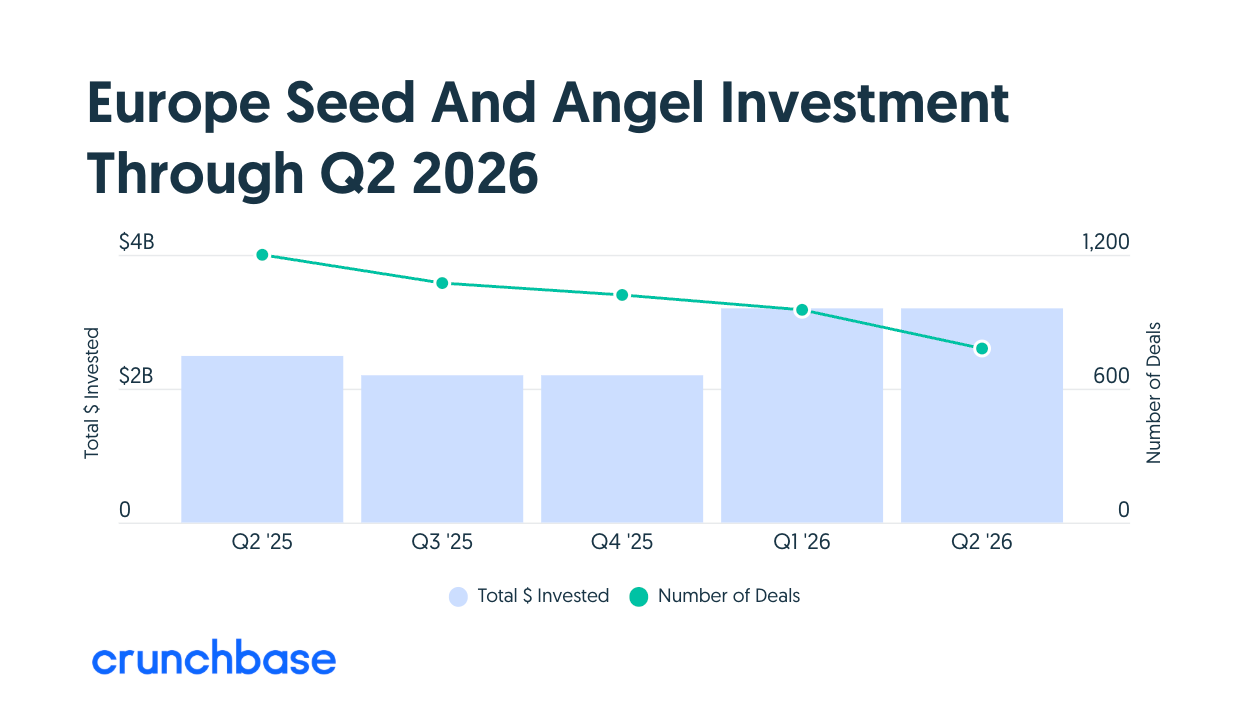
Seed funding told a slightly different story, totaling $3.2B for the quarter, though a full billion of that came from a single company, Ineffable Intelligence. Take that one deal out and seed activity looks a lot more modest, which fits the pattern we've seen all year: fewer but bigger bets rather than money spread thin across the market.
Late-stage funding kept climbing in Q2, hitting $12.1B, a 90% jump from a year earlier. Investors are clearly comfortable putting large sums behind companies that have already proven themselves, even while the earlier stages of the market stay more cautious.
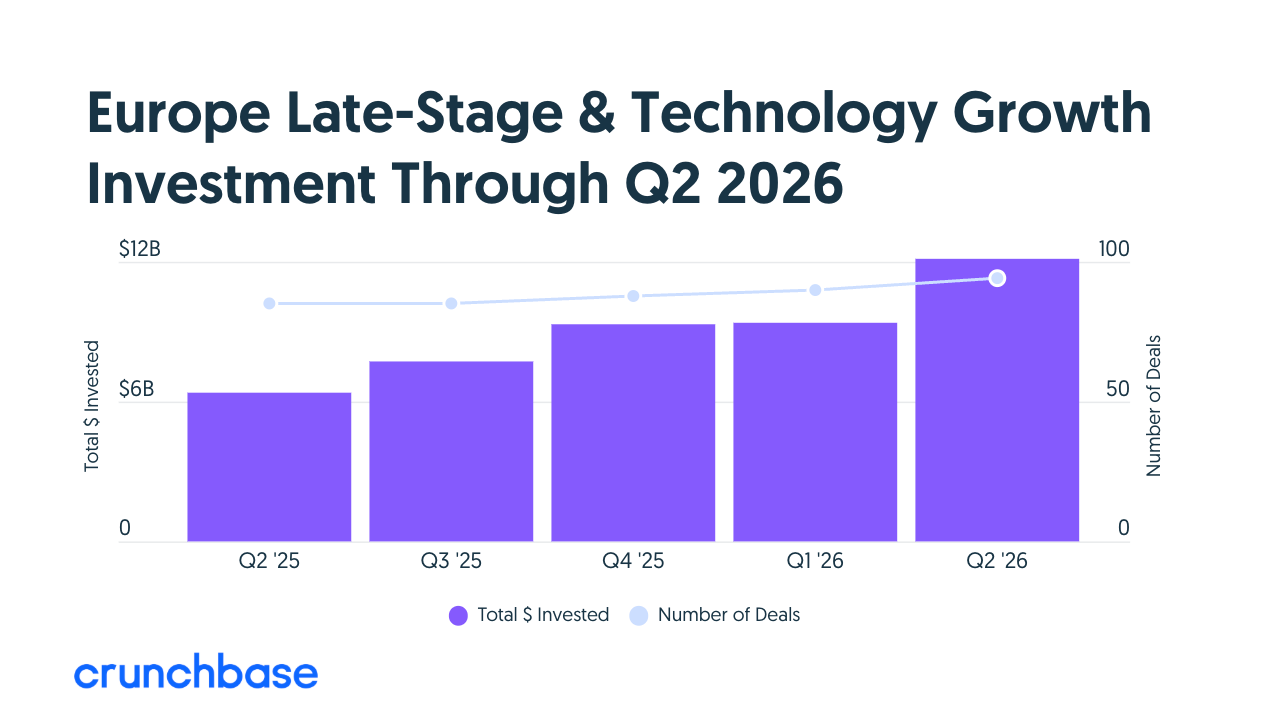
The quarter's big Series C and D rounds went to Neura Robotics, a German robotics company; Nearfield Instruments, a Netherlands-based maker of semiconductor inspection tools; Oxford Quantum Circuits, a U.K. quantum computing startup; and Isar Aerospace, a German satellite launch company. It's a reminder that late-stage money isn't just chasing AI right now — robotics, chips, quantum, and space are all pulling in serious capital too.
The fundraising environment in 2026 isn't necessarily harder than it was a year ago; it's just a little bit more selective.
Capital remains available, and in many cases investors are writing larger checks than before. But that capital is increasingly concentrated in fewer companies, particularly those operating in AI, deeptech, climate, robotics, semiconductors, and other sectors with strong long-term growth narratives. Across the market, investors continue to prioritize conviction over volume, backing startups that can demonstrate meaningful traction, clear differentiation, and a credible path to scale.
For early-stage founders, this means fundraising is still very much possible, but expectations are different. Strong teams, early customer validation, capital efficiency, and a compelling story matter more than ever. Investors are taking longer to make decisions and conducting deeper diligence, making preparation a competitive advantage.
One encouraging signal is that European venture fundraising is beginning to recover after several slower years, while US investors continue to increase their participation in European rounds. That expands the pool of available capital for ambitious founders, particularly those building globally relevant businesses.
If you want to connect with VC funds or check out other active investors in the region, check out SeedBlink’s European VC Network list covering venture capital funds from SEE, DACH, Benelux, and others.
Want to secure a larger investment from multiple angel investors? Consider more flexible funding options for your next round, such as SeedBlink's syndicate infrastructure and rolling facility, which enable continuous fundraising.
Written by

Patricia Borlovan
Communication Specialist
TABLE OF CONTENT

Subscribe to our newsletter
No spam. Just the latest releases and tips, interesting articles, and exclusive interviews in your inbox every week.
Share this article
The latest news, technologies, and resources from our team.




%20-%20Ready%20to%20invest_%20European%20VC_Q2%202026.png)
%20-%20Ready%20to%20invest_%20European%20VC_Q1%202026.png)
%20-%20European%20VCs%201.png)
%20-%20convincing%20pitch%20deck.png)