Prepare to raise | CORE
Expert guidance, investor matching, and visibility
Private rounds
Raise from your network with professional infrastructure
Cap table & equity management
All-in-one equity and stakeholder management
ESOP
Incentivize your employees and manage ESOPs seamlessly
Explore SeedBlink Legal

Newsletter
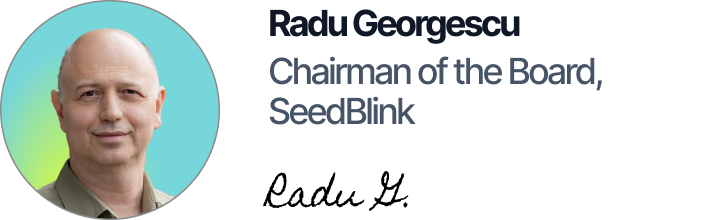
This week's edition of The Blink: Radu Georgescu on the three cycles every company lives through, why founder-CEOs are most likely to be replaced when things go well, the UNTOLD round closing, and the week's reads.
September 7, 2026
·
5
min read

The European private markets briefing you can't afford to miss. Deals, signals, and moves, decoded every Monday by SeedBlink.

Most companies do not have one life. They live through three cycles, and each one asks for a different kind of leadership.
The first cycle is technological. The company builds a product, and whoever runs it is measured on whether the technology works. The second is commercial. The product exists, so the question becomes how many users you can put it in front of. The third is financial, when profitability becomes the measure that matters.
I watched this play out at a mobile operator in the Romanian market. The first chief executive was an engineer whose job was putting up antennas. When the antennas were done, he left to put up antennas in another country. The next one was a salesman whose job was getting SIM cards into as many pockets as possible. The one after that came from finance and brought order to the cost base. The company became profitable, and it was acquired.
Each of them was right for the cycle they were in, and would have been wrong for the other two.
Finishing a cycle requires a significant change inside the company, and the ones that skip it plateau and then decline. Which is also where the timing of an exit comes in. The moment to sell is roughly 10 to 20% before the peak. You have to leave money on the table, because you are also leaving the buyer the time and the fuel to execute the next cycle themselves. Sell after the plateau, and the buyer may have too little of either.

Founder-CEOs are most likely to lose the job when the company is doing well.
That is the counterintuitive core of what Noam Wasserman called the paradox of entrepreneurial success. Studying succession at 202 venture-backed companies, he found the expected pattern for poor performance, but also its mirror image: founders whose companies performed exceptionally were far more likely to be replaced too. Two milestones triggered it most reliably, completing product development and closing each new round of outside financing. The founders most likely to keep the job were running companies doing neither badly nor especially well.
The same shape appears outside the US. Studying 4,172 Danish single-founder startups, Chen and Thompson found replacement concentrated at both extremes, the weakest firms and the strongest, which is what you would expect if boards are matching leadership to the phase rather than simply punishing failure.
The reason is structural rather than personal. Success moves a company into its next phase faster, and the next phase asks for different skills.
What happens after replacement has better evidence than it used to. Ewens and Marx examined more than 22,000 US venture-backed startups founded between 1995 and 2008. The raw correlation looked unflattering, which is what you would expect if investors mostly replace founders at troubled companies. Isolating cause from effect through changes in how 14 states enforced non-compete agreements, the sign reversed: replacement improved performance, most clearly when the founder had held a C-level role and left the company afterwards.
The rigorous work on this question is a decade or more old, which reflects how hard the causal question is rather than how settled it is. The pattern itself is still visible in current data. Among 590 of Europe's largest listed companies, Spencer Stuart found that 21% of new chief executives in 2025 came directly from the CFO seat, and average tenure fell to 7.4 years from a peak of 8.8 in 2022. A different population entirely, but the same logic: boards match the leader to the phase, and the phases are getting shorter.
The practical read is quieter than the headline. Succession is almost never discussed before it becomes urgent, which is precisely when it goes badly. For founders, the useful question is not whether you will still be the right person in three years, but what would have to be true for you to notice if you weren't. For investors, a board that has never raised the subject has not decided the founder should stay. It simply hasn't thought about it.

The UNTOLD round is closing soon
Here’s a short recap: UNTOLD is ranked #3 worldwide by DJ Mag for the third year running. Its 11th edition drew more than 500,000 attendees from over 130 countries, and more than 30,000 people have already bought passes for next year, weeks after this one ended. Behind the festival is a business that stayed profitable while growing revenue nearly 28% last year, to €28.7M, with sponsors including Pepsi, Visa and Banca Transilvania adding a revenue line on top of ticketing.

Germany 🇩🇪
Atira raises $17.5M
Munich-based Atira closed a $15M seed led by Accel, plus a previously undisclosed $2.5M pre-seed, to automate industrial sales engineering, a workflow the company estimates accounts for over $128bn in annual labour spending worldwide. One customer reports processing quote requests 80% faster.
Belgium 🇧🇪
Octave.energy raises €10M Series A
The Mechelen-based cleantech raised €10M in a mix of equity and flexible debt, led by SPDG Growth with BNP Paribas Fortis and KBC participating, to scale battery storage and energy management systems for industrial sites, SMEs and farms across Europe.
UK 🇬🇧
AI Score raises $5.4M seed
London-based AI Score raised £4M led by Fuel Ventures for a platform that monitors how companies actually use generative and agentic AI. The advisory bench is unusually heavy for seed stage: former GCHQ director Sir Jeremy Fleming, Starling Bank's chair, and a Darktrace co-founder.

Startup ARR is less secure than ever
New Madrona research finds 77% of enterprises now re-evaluate their AI vendors every six months or on a rolling basis, a "fast in, fast out" dynamic with no equivalent in the SaaS era.
Why venture capital is still constrained by geography
Fluent Ventures' Alex Lazarow on a gap he has tracked for a decade: talent is global, capital is provincial. Europe's ecosystem is now worth roughly $5.6 trillion with over 200 unicorns, yet more than 90% of venture dollars go to AI-native companies concentrated in a handful of US names.
"I want to build a decacorn": the former Legora and Revolut employee betting big on legaltech
Michelle Cotter is closing a €1M pre-seed for Juritas, a Stockholm company that tracks the commitments buried inside contracts. On what she learned about ambition from Nik Storonsky and Max Junestrand, the difference between a community and a network, and the antique typewriter she bought to keep AI from turning her brain to mush.
Written by

Denisa Lacatus
Communication and Content Specialist
TABLE OF CONTENT

Subscribe to our newsletter
No spam. Just the latest releases and tips, interesting articles, and exclusive interviews in your inbox every week.
Share this article
The latest news, technologies, and resources from our team.