Prepare to raise | CORE
Expert guidance, investor matching, and visibility
Private rounds
Raise from your network with professional infrastructure
Cap table & equity management
All-in-one equity and stakeholder management
ESOP
Incentivize your employees and manage ESOPs seamlessly
Explore SeedBlink Legal

Fundraising
Discover the latest fundraising insights in European venture capital that influenced the third quarter of this year.
October 30, 2026
·
5
min read

European venture capital closed Q3 2026 on its strongest footing in four years. Funding edged past Q2's total, AI took a record share of the capital, and late-stage rounds absorbed most of the money, while seed and early-stage activity cooled.
The divergence we signaled in Q2 hasn't gone away; it has only become more visible. Investors are writing bigger checks into fewer companies, and a handful of billion-dollar rounds now account for a large slice of the quarter. For founders, capital is clearly available, but the bar to reach it keeps rising.
Today, we break down the latest data from Crunchbase, PitchBook, and KPMG to examine how fundraising, deal activity, investor behavior, and sector trends evolved across Europe during Q3 2026. Whether you're preparing for a seed round or planning a later-stage raise, these insights offer a clearer picture of where capital is going and what founders should expect heading into 2027.
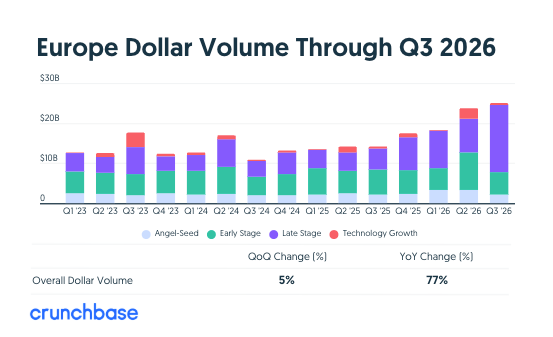
The story of Q3 2026 is one of scale and concentration. European startup funding reached $25B last quarter, up 77% year over year from $14B in Q3 2025 and slightly above Q2's $24B, according to Crunchbase. That makes it the region's strongest quarter in four years, and the second quarter this year above $20B, a level Europe hadn't reached since Q3 2022.
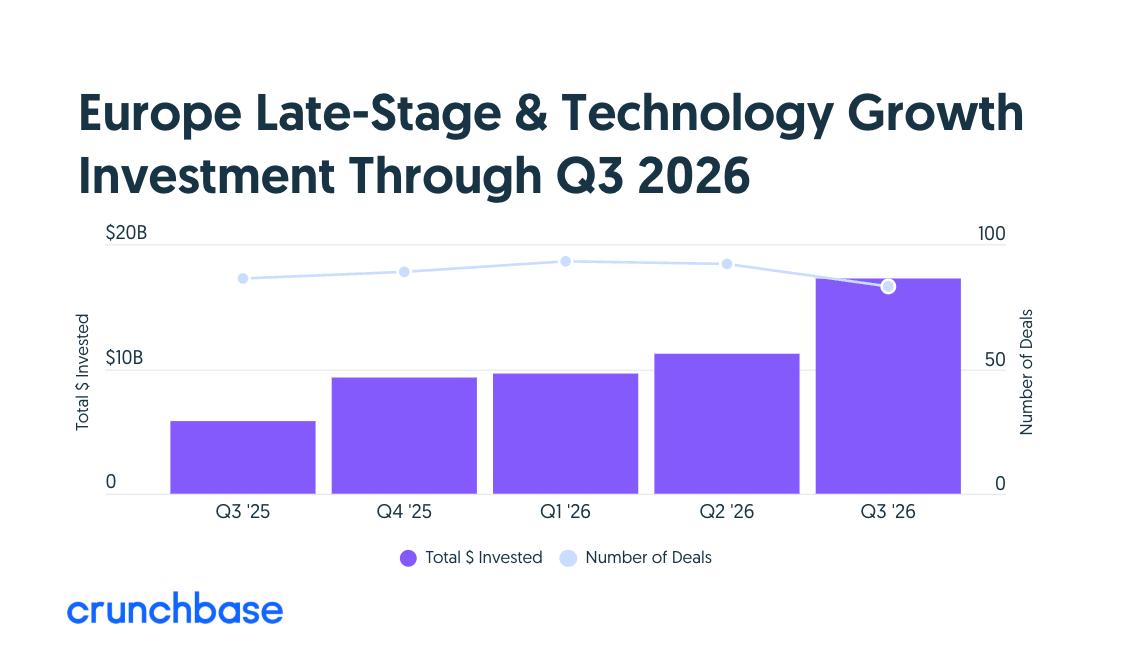
But the headline hides a sharp imbalance. Late-stage deals absorbed $17.3B, or 70% of the quarter's capital, across just 83 companies. Early-stage and seed funding both fell quarter over quarter and were flat year over year. In other words, the hollowing out at the bottom we described in Q2 continued, while the top of the market pulled further ahead.
Billion-dollar rounds did much of the heavy lifting. Four European companies raised rounds of $1B or more, together accounting for close to 40% of the region's startup capital in Q3. Paris-based Mistral raised $3.5B, the largest venture round ever for a Europe-based company.
Physical tech, spanning defense, data centers, energy, aerospace and robotics, accounted for roughly half of European funding in the quarter. That is a notable change from the software-heavy rounds that dominated previous cycles.
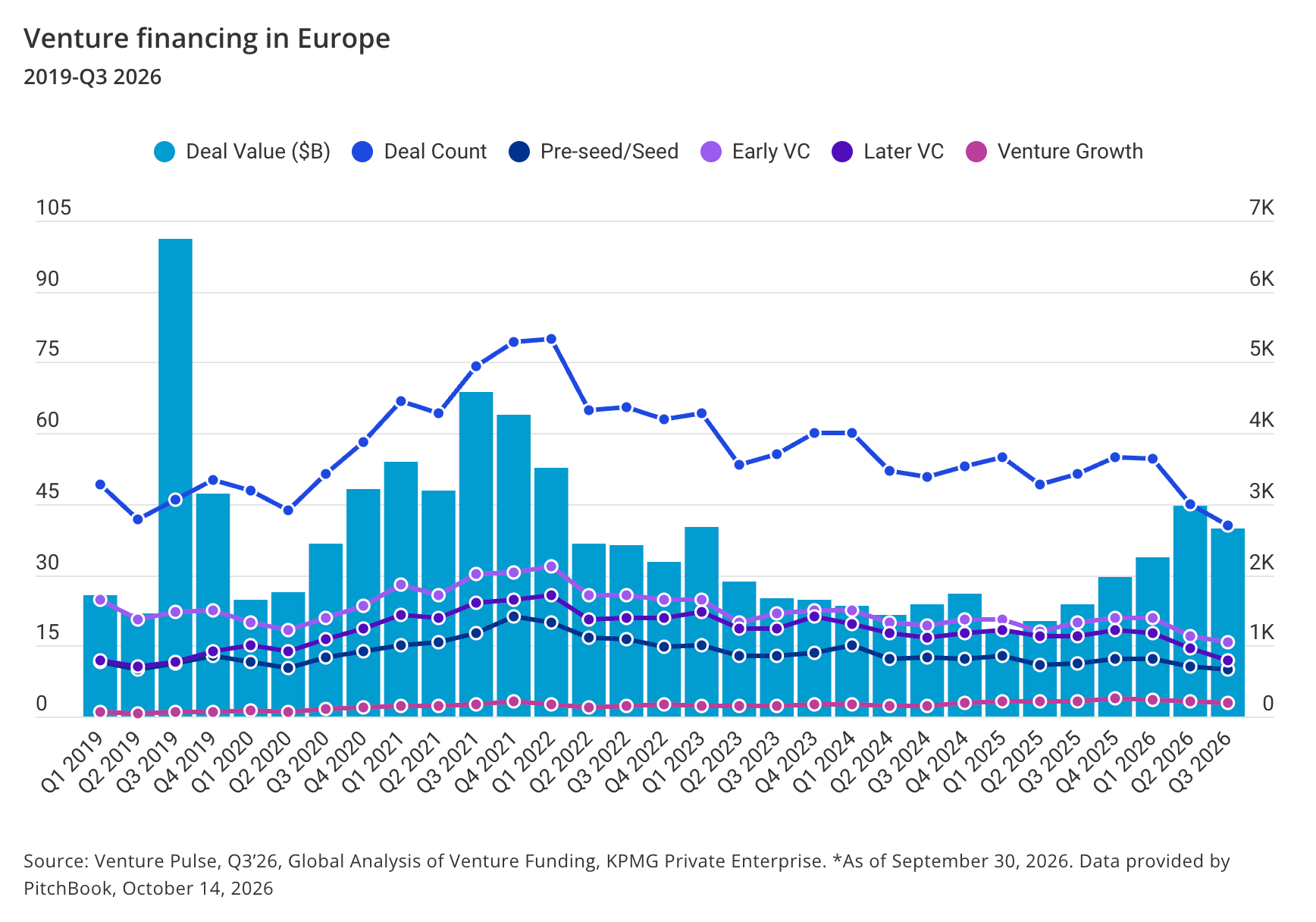
KPMG data confirms the trend from a different angle. Total VC investment in Europe reached $28.4B across 1,497 deals in Q3, up from a revised $26.5B in Q2. It was Europe's eighth consecutive quarter of growth and its highest total in 16 quarters. Deal count kept falling, though: the 1,636 deals initially reported for Q2 fell to 1,497 in Q3, as more capital went into fewer companies.
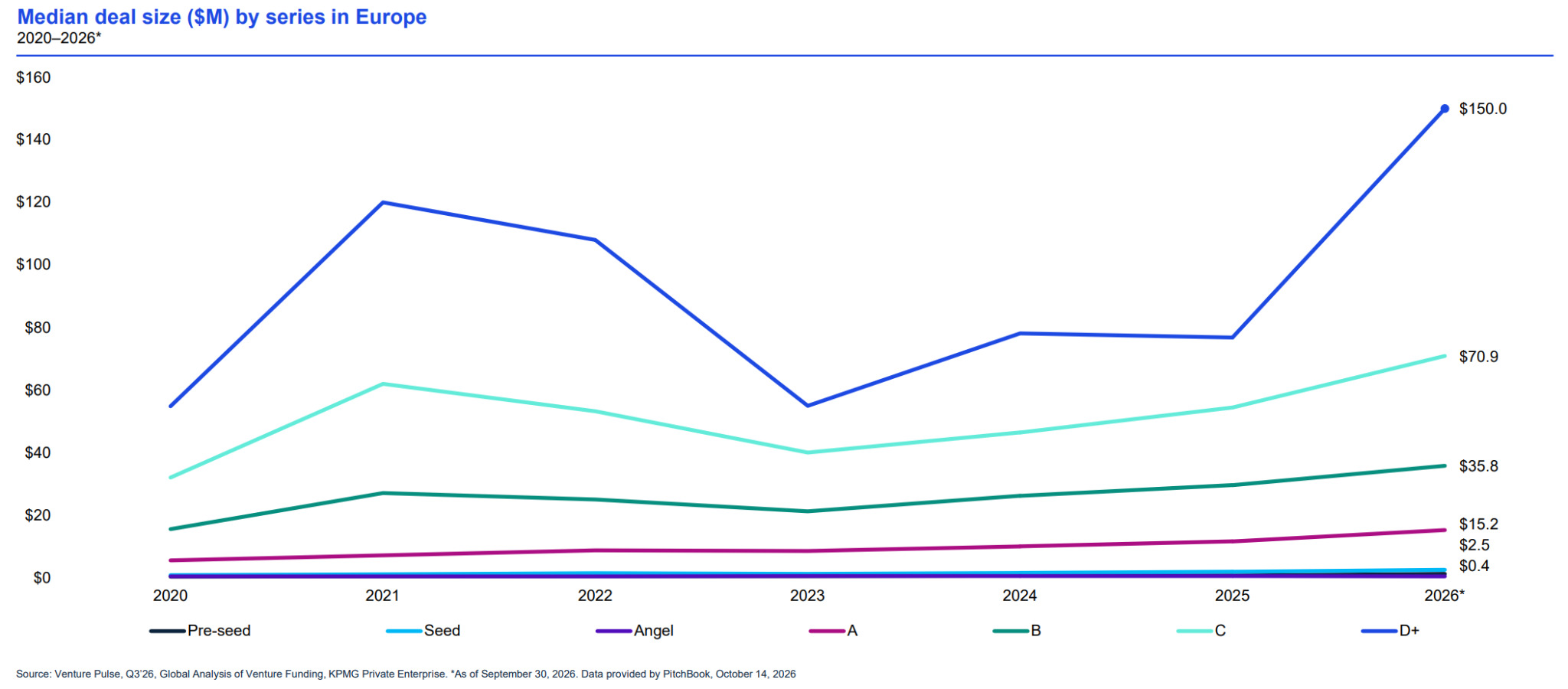
Pricing kept climbing, and down rounds remained the exception. Rounds in Europe kept getting bigger. According to KPMG, a typical European seed round in 2026 is about $2.5M, while a typical Series A is now $15.2M, a Series B $35.8M and a Series C $70.9M.
Valuations are rising too. Before new money comes in, a typical European startup is valued at $43.4M at Series A, $130M at Series B, and $397.5M at Series C. KPMG says valuations are starting to look stretched, partly because governments are buying more defense and AI technology from European companies.
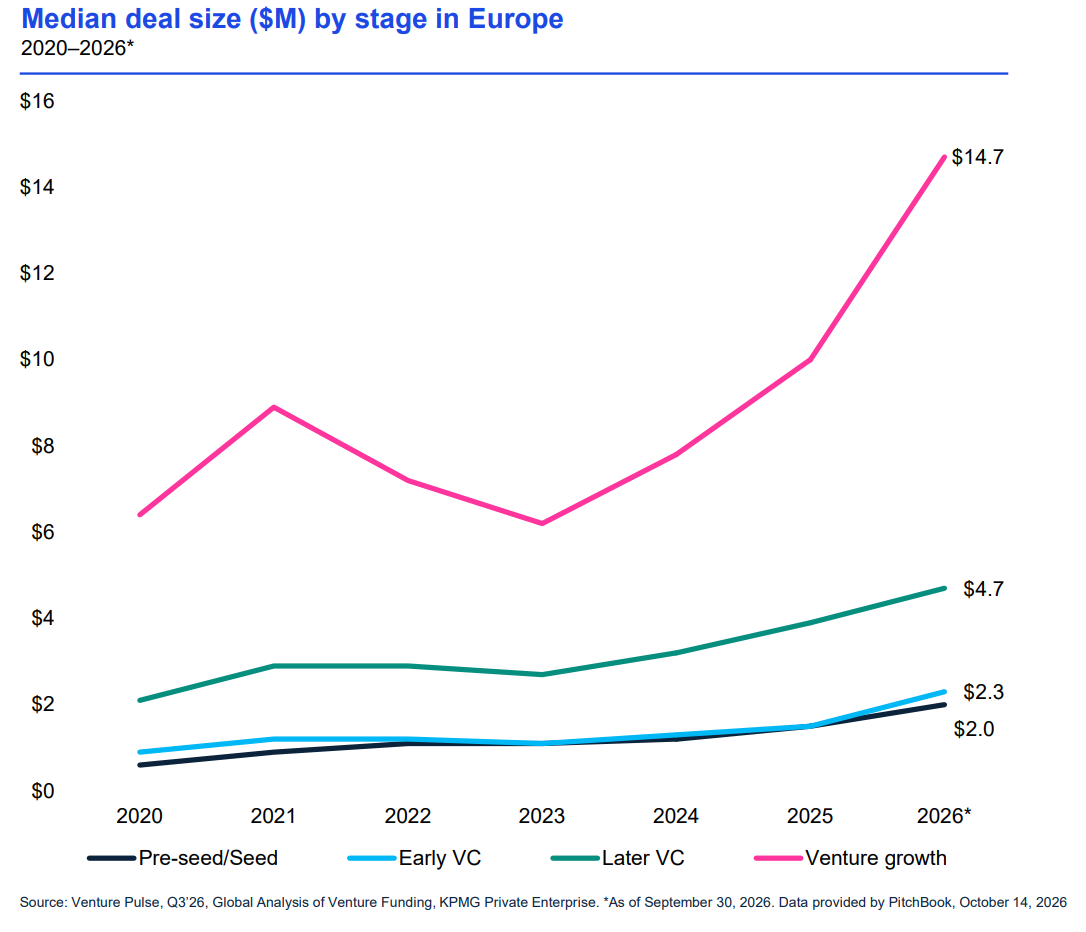
The split between the earliest and latest stages persists. By number of deals, pre-seed and seed rounds still make up the majority of European transactions. By dollars invested, Series B, C, and D+ rounds continue to take the bulk of the capital, as KPMG's deal-share data shows.
VC fundraising in Europe is finally showing clear signs of recovery, though the money is concentrating in the largest vehicles. According to PitchBook, Q3 was driven by megafund closes, above all EQT’s appointment to manage the €5B Scaleup Europe Fund, while the market outside the megafunds remained more constrained.
KPMG's data, based on PitchBook figures, puts European VC fundraising at $14.9B across 111 funds through the end of Q3. That is already close to the $15.5B raised in all of 2025, and the report says the current fundraising pace puts 2026 on track to beat last year’s total.
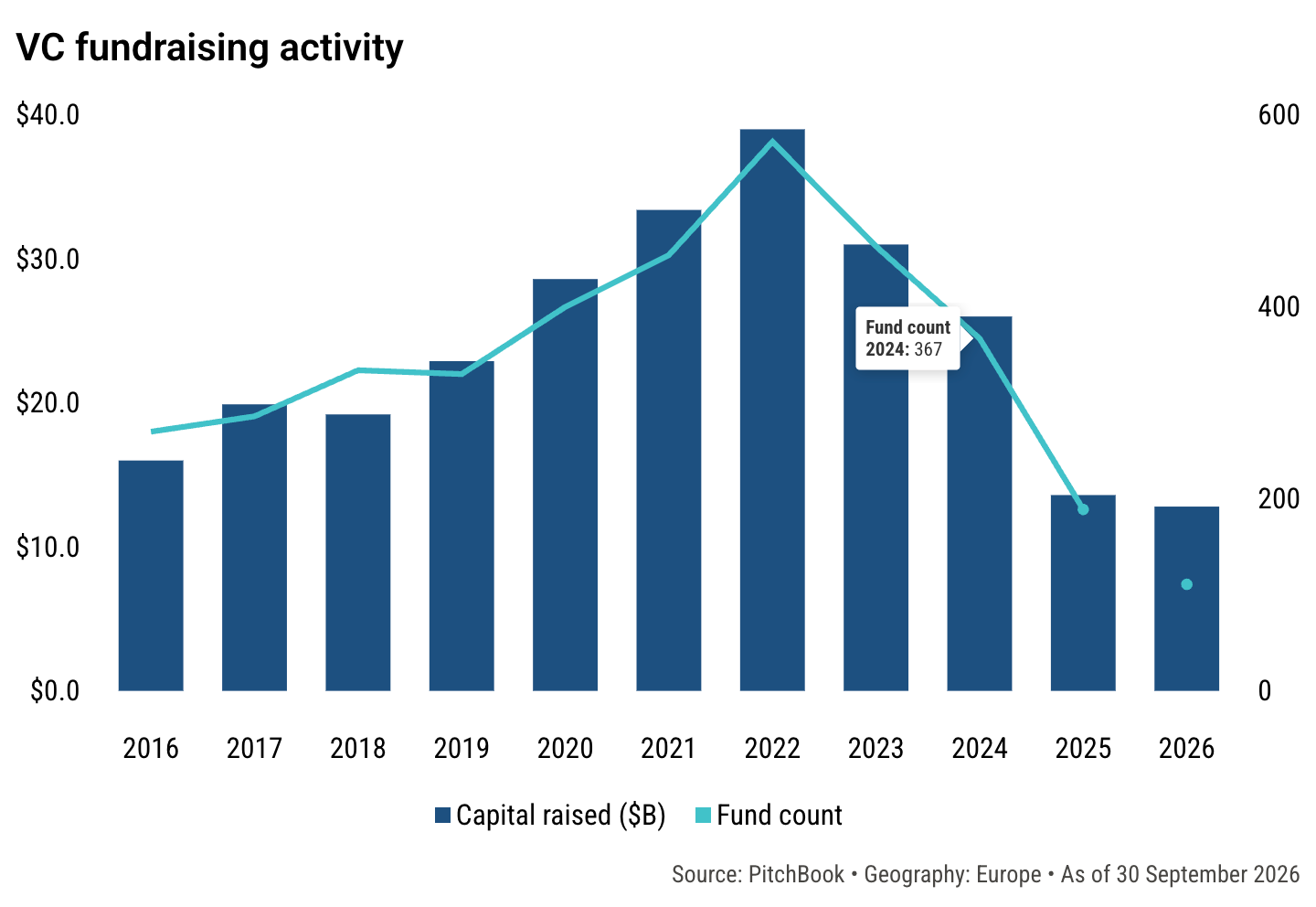
Public capital is stepping into late-stage funding, but it won't close the gap alone. The EU's €5B Scaleup Europe Fund is the largest raise by a European fund since Innovate UK's €6B-plus in 2017, according to PitchBook.
Managed by EQT, it blends EU money with commitments from pension funds, sovereign-linked investors and banks, and targets rounds of €100M to €500M from Series B onward in AI, quantum, dual-use tech, clean energy, space and biotech. The fund's full €5B equals about 7% of the €68.4B invested in European startups so far this year, and some reports suggest only part of that target has been committed at first close.
US investors keep playing a bigger role. PitchBook notes that a US investor took part in a record 22.2% of European deals this year, up from a previous peak of 21.5% in 2022. Nontraditional investors such as corporates and sovereign funds also stayed active, joining 40.7% of deals that together account for 83.7% of deal value. Crunchbase also notes that many of the quarter's leading rounds were sourced across multiple European countries.
For a closer look at where momentum is building, read our recent article covering the venture funds raised in Europe during the second quarter of this year.
European VC deal activity kept accelerating through Q3 2026, with AI investment running well ahead of expectations. According to PitchBook, AI-related deals now account for nearly two-thirds of all European deal value this year, up from 60% earlier in the year and 41% in 2025. AI investment has reached €44.1B so far in 2026, already more than in all of 2025, and is on course to double last year's total.
Overall, European deal value reached €68.4B through Q3, including €24.6B in the third quarter alone. If that pace holds, 2026 would end 31% above 2025. Rounds of €100M or more now make up 59.2% of deal value this year, but only 1.5% of deals.
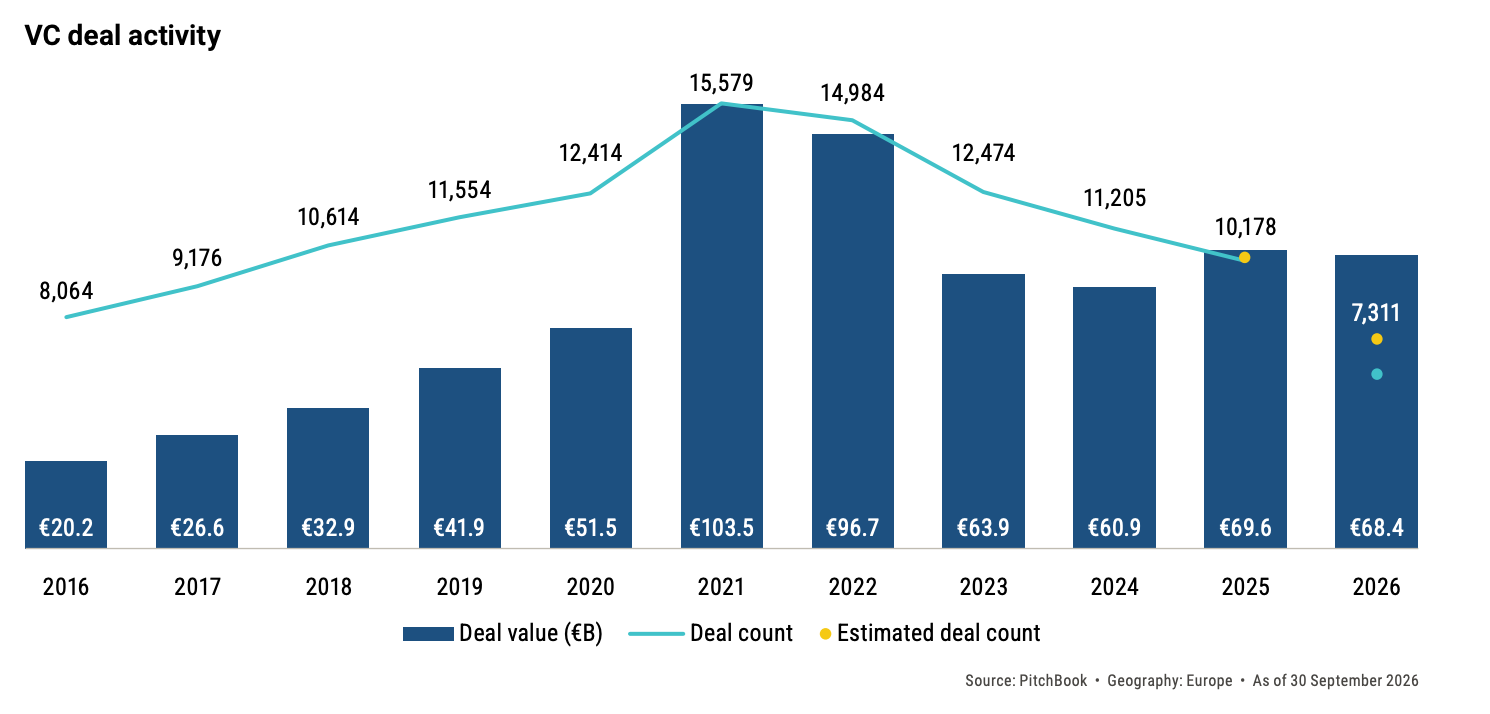
AI continued to anchor the market, and Crunchbase’s numbers show just how concentrated it has become: AI companies raised $18.8B in Q3 alone, or 75% of all European funding, the highest share on record.
Fewer deals, bigger checks. KPMG's count of 1,497 deals in Q3 is one of the lowest in years, even as deal value hit a 16-quarter high. TheVentureCity's analysis puts the average European deal at roughly $19M in Q3, up from about $13M in Q2. A small number of outsized deals are doing a disproportionate share of the work.
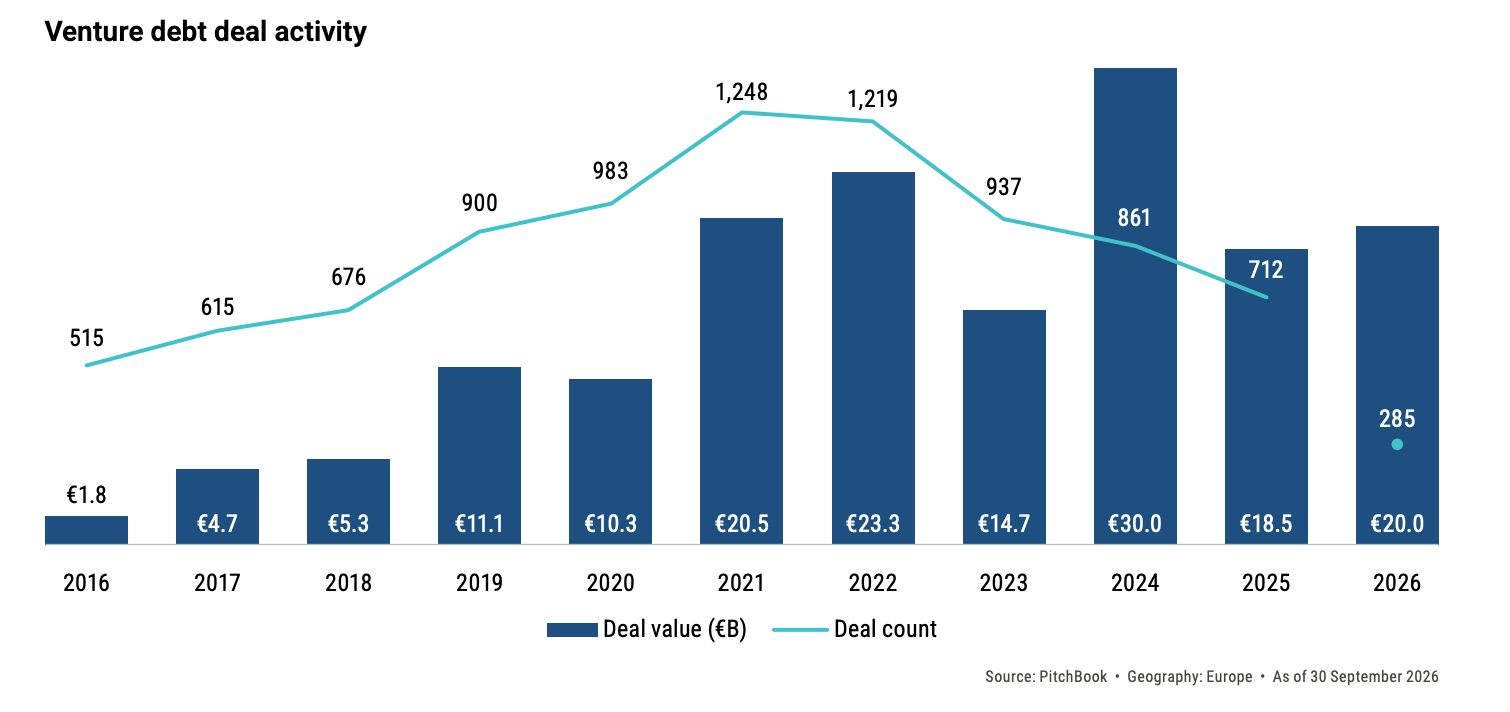
Venture debt is filling part of the gap. PitchBook also reports that venture debt remained resilient in Q3, as later-stage companies leaned on debt financing while the IPO market stayed less accommodating. Larger debt deals pushed up average transaction sizes, and Nscale's $3.36B convertible note was the clearest example this quarter.
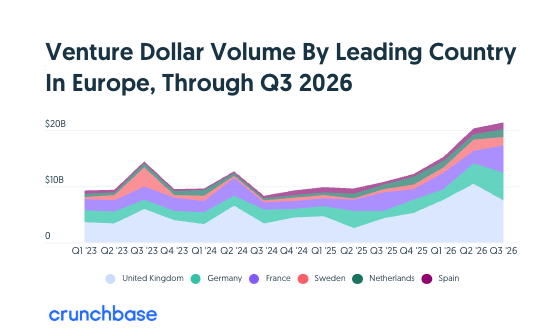
The UK kept its lead, but the venture map is widening. UK-based startups raised $7.5B in Q3, according to Crunchbase, well below Q2's 10.4B. Germany (5B) and France ($4.8B) both gained market share, each posting their strongest quarter since the boom years of 2021 and early 2022.
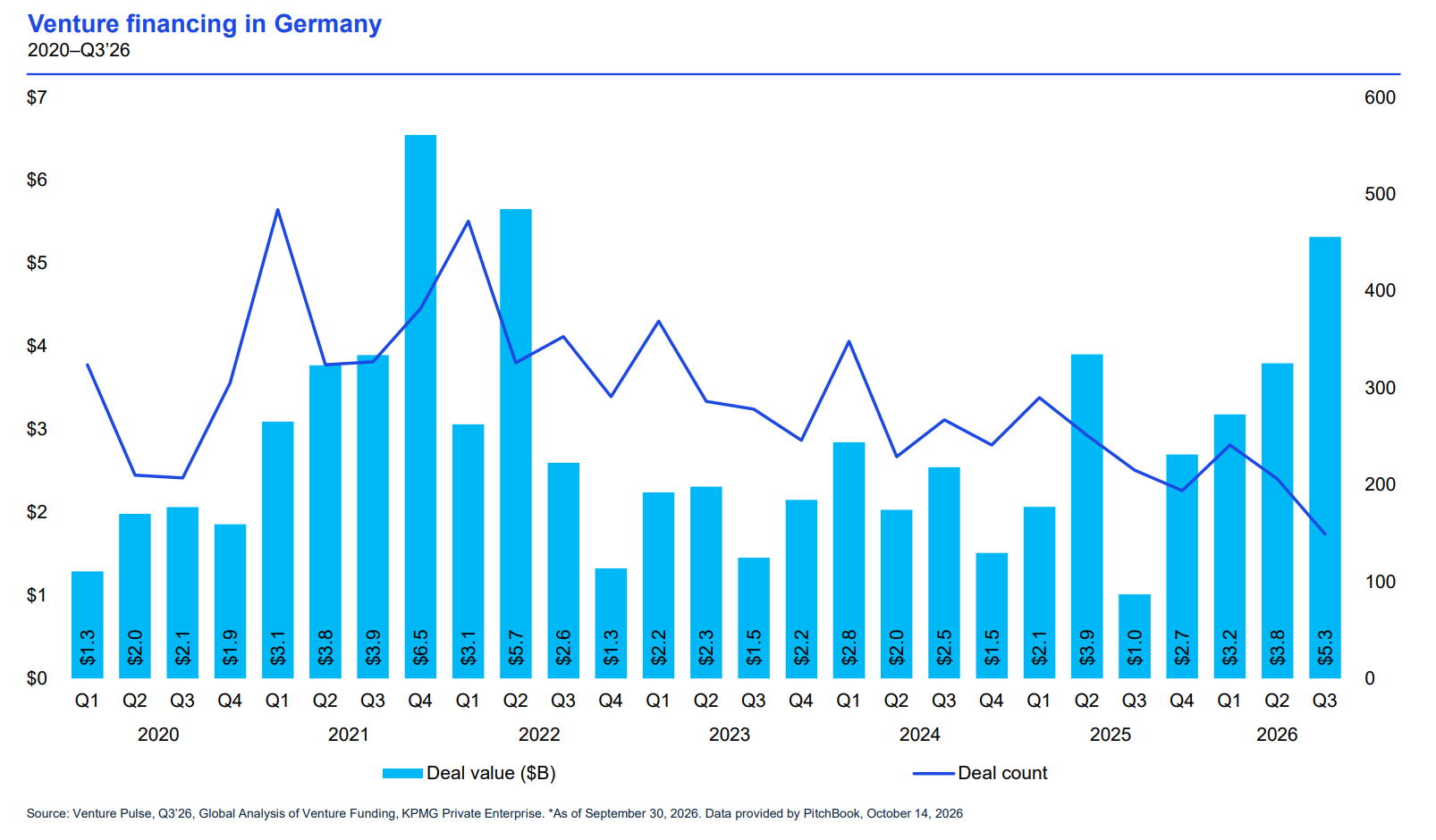
Germany is the breakout story of the quarter. KPMG data shows German VC investment reached $5.3B in Q3, its fourth straight quarterly increase and the highest level since Q2 2022.
France also hit a multi-quarter high on the back of one deal. KPMG puts French VC investment at $4.9B in Q3, with Paris alone at $4.6B, largely thanks to Mistral AI's $3.5B Series D.
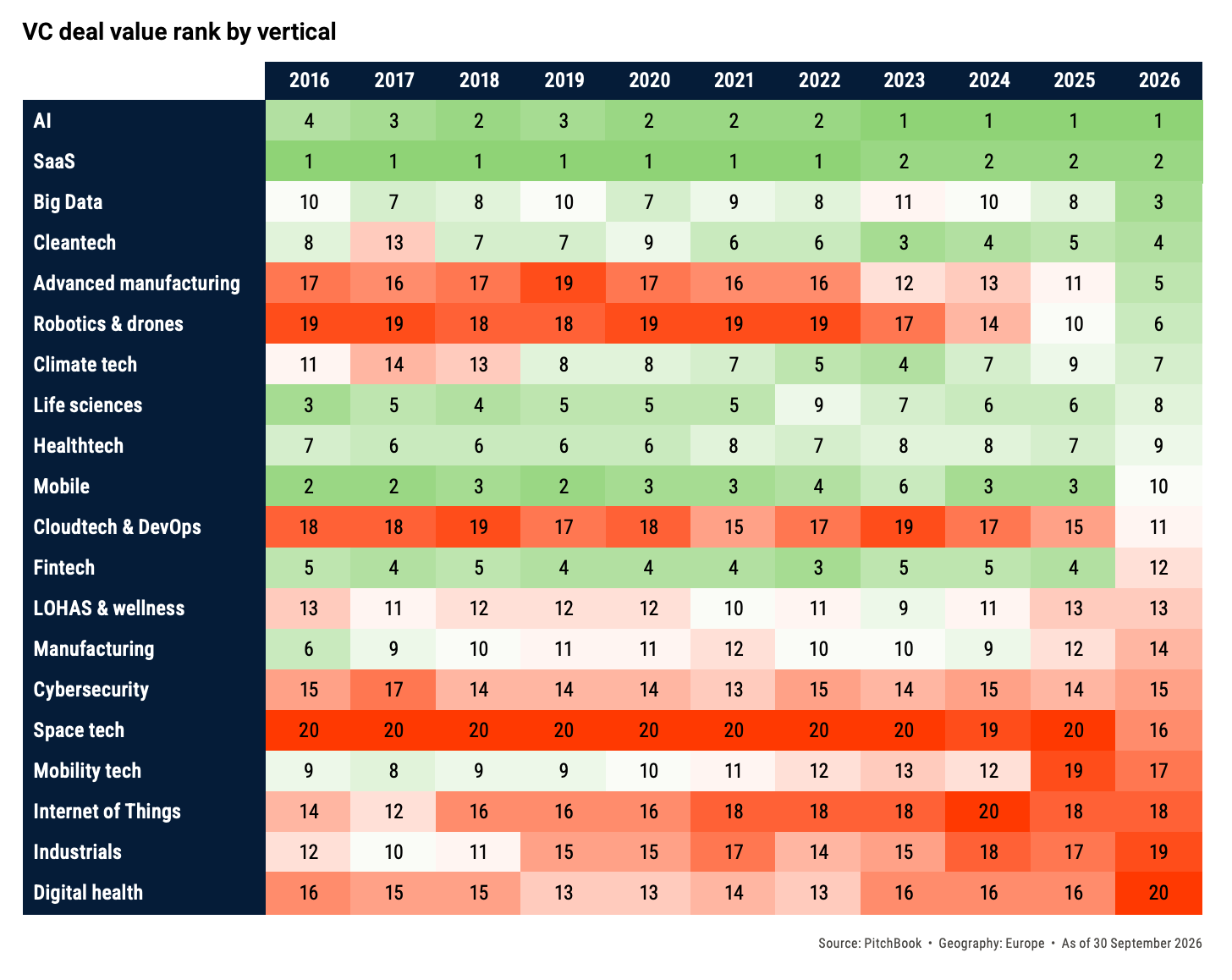
AI remains Europe's top vertical by deal value, and its lead keeps widening: €44.1B has gone into AI so far in 2026, already more than in all of 2025. But the more interesting change in Q3 is underneath it: PitchBook's Q3 data shows that most of Europe's fastest-growing verticals this year are deep tech.
The top 3 has changed since Q2. In PitchBook's ranking by deal value, AI and SaaS still hold first and second place, but Big Data, a category closely tied to AI rounds, has jumped to third from eighth in 2025.
Cleantech slipped to fourth, even though it is still growing fast, with €10B invested so far this year, up 41.8%. Its largest rounds included Proxima Fusion (€411M), CuspAI (nearly €400M) and Euclyd (around €200M). Advanced manufacturing (5th) and robotics and drones (6th) round out the climbers. Fintech is seeing the biggest loss, falling from fourth place in 2025 to 12th as capital moved to sectors with more AI exposure.
The common thread is Europe's push for technological sovereignty. As governments open procurement for defense, sovereign AI, and critical infrastructure, investors are betting on companies that can win long-term contracts rather than on another wave of consumer software.
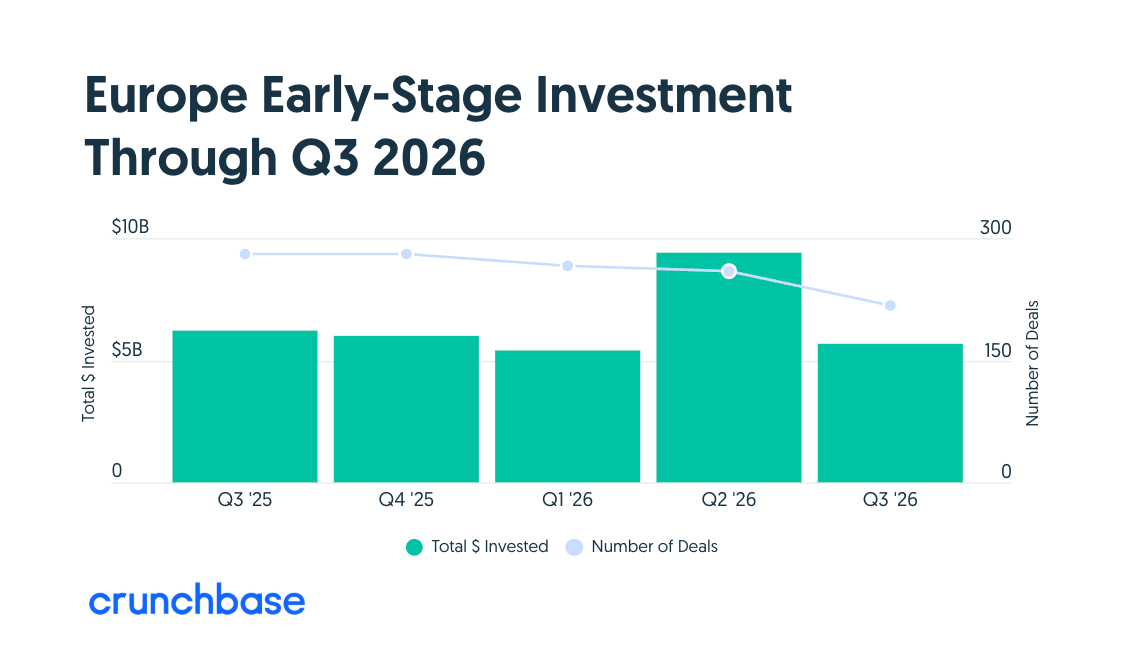
After bouncing back in Q2, early-stage funding in Europe cooled in Q3. Series A and B rounds totaled $5.7B across just over 200 companies, according to Crunchbase, down from $8.6B in Q2 and flat year over year. Investors are still writing large checks at this stage, but to a narrower set of companies.
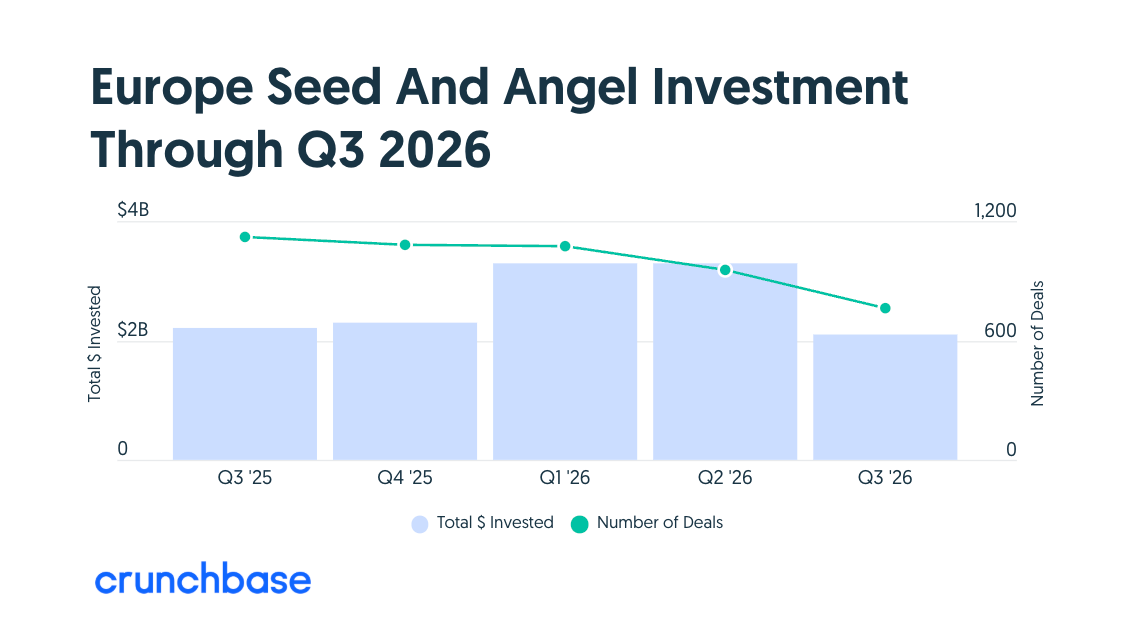
Seed funding stayed under pressure. Around $2B went into more than 750 companies at seed stage in Q3, down quarter over quarter and flat year over year. Unlike Q2, when a single $1B deal for Ineffable Intelligence inflated the total, there was no outlier this time.
Late-stage funding was the engine of the quarter. It reached $17.3B across 83 companies in Q3, according to Crunchbase, up from $12.1B in Q2 and equal to 70% of all European venture capital raised. Europe as a whole captured 16% of global venture capital in the quarter.
Beyond the billion-dollar rounds for Mistral, Helsing and Quantum Systems, a second tier of large late-stage deals between $400M and $700M went to Stockholm-based health scanning provider Neko Health, Portuguese-founded autonomous drone developer Tekever, Spain's Multiverse Computing (model compression for enterprise AI), Amsterdam-based AI deployment startup Wonderful, Bavaria's The Exploration Company in space transportation, and Stockholm-based AI app builder Lovable.
The list reminds us that late-stage capital is no longer confined to London. These rounds span more countries, and defense, health, space, and AI infrastructure all feature.
The fundraising environment heading into 2027 isn't short of capital; it's short of breadth. Europe just posted its strongest quarter in four years, yet most of that money went to fewer than 100 late-stage companies.
Capital remains available, and investors are writing larger checks than ever before. But it is concentrated in AI and in the physical technologies that support it, such as defense, robotics, semiconductors, energy and space. For early-stage founders, this means raising is harder than before. Seed and Series A investors are backing fewer companies, so they look closely at the team, early customers, how carefully money is spent, and what makes the business hard to copy. Software companies outside AI should also be ready to explain how AI affects their product and market.
There is also good news. European VC funds are raising more money again and are on pace to beat 2025, and US investors are joining more European rounds than ever. This means more money is available for founders, especially those building companies that can sell worldwide.
If you want to connect with VC funds or check out other active investors in the region, explore SeedBlink's European VC Network list covering venture capital funds from SEE, DACH, Benelux, and other regions.
Want to secure a larger investment from multiple angel investors? Consider more flexible funding options for your next round, such as SeedBlink's syndicate infrastructure and rolling facility, which enable continuous fundraising.
Written by

Patricia Borlovan
Communication Specialist
TABLE OF CONTENT

Subscribe to our newsletter
No spam. Just the latest releases and tips, interesting articles, and exclusive interviews in your inbox every week.
Share this article
The latest news, technologies, and resources from our team.