Prepare to raise | CORE
Expert guidance, investor matching, and visibility
Private rounds
Raise from your network with professional infrastructure
Cap table & equity management
All-in-one equity and stakeholder management
ESOP
Incentivize your employees and manage ESOPs seamlessly
Explore SeedBlink Legal

Secondaries
Private markets are decoupling from public stocks. See why timelines are longer, liquidity comes earlier, and secondaries influence fundraising.
December 3, 2025
·
3
min read
%20-%20private%20market%201.png)
Private markets are entering a new phase of maturity, reshaping how startups grow and how investors allocate capital. Over the past decade, companies have begun staying private far longer than they used to.
Today, we sit down to look at some of the major trends that we identified in the market in the past months: why companies are staying private longer, how private markets are becoming less correlated with public ones, and why secondaries and early liquidity discussions are now part of the fundraising journey.
In the past, the typical path was to raise a few rounds, scale quickly, and head for an IPO in about 5 to 9 years. Now, the average is closer to sixteen years, and this change is driven by one big factor: private markets are overflowing with capital. When companies stay private for 12–16 years instead of 6–8, their valuations get updated only when a new round is raised or a meaningful secondary sale happens, sometimes once every year or two.
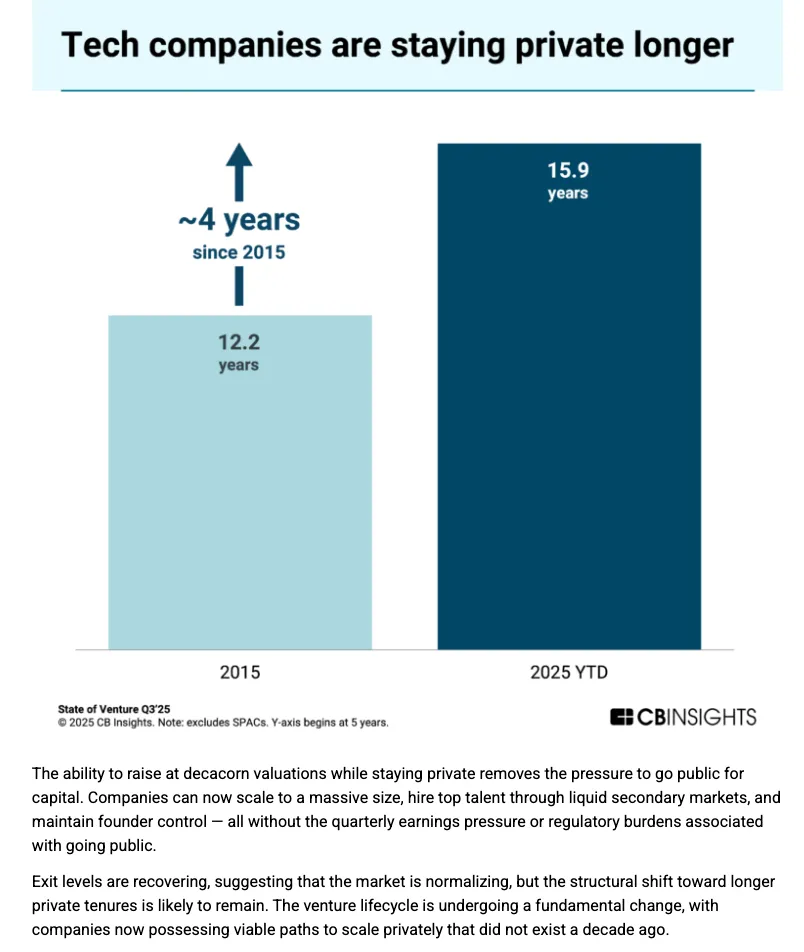
Source: State of Venture Q3 2025 by CB Insights
Because of that, liquidity shows up in fewer moments but in much bigger sizes. Investors who play in the private markets like that stability, but they also know they’ll be tying up capital for longer and need to plan carefully for when money actually returns to them.
Founders, especially in fast-growing tech and AI, feel less urgency to go public because the private markets have become incredibly deep. Late-stage funds, crossover investors, sovereign wealth funds, and even some retail structures are pouring huge amounts of money into private companies.
On top of that, regulatory changes over the last decade have made it easier for more pools of capital, including pension funds and large allocators, to invest directly into private assets. All of this means a promising company can raise hundreds of millions, or even billions, without ever setting foot in the public markets. Still, as the Financial Times and other analysts point out, companies still need IPOs, and they continue to play an important role in the system.
This also changes how the broader venture ecosystem behaves. When companies stay private longer, liquidity events, such as IPOs, acquisitions, and major exits, come less often. For investors, that means returns take more time. For the market, it means valuations move more slowly and aren’t whipsawed by public-market sentiment. Overall, it creates a more patient but less predictable environment.
As a founder raising capital now, this means your investors may expect you to build for a much longer runway before any liquidity event. Investors know their capital may be locked up for a long time, so they’re looking harder at business fundamentals, market fit, and long-term durability. They want to believe a company can grow steadily through multiple rounds before any kind of exit becomes realistic.
At the same time, staying private longer means you may have more chances to raise significant follow-on capital if your startup gains traction.
The fact that companies are staying private longer doesn’t just change the startup journey; it changes how the entire private market behaves. When more value is created and stored inside private companies for a decade or more, you naturally end up with an investment ecosystem that moves on its own timeline.
That’s exactly what we’re seeing now. Private markets are starting to move away from the rhythm of public stocks.
Recent data from Pitchbook shows that the five-year correlation between private-market assets and the S&P 500 has been falling. That basically means private equity, venture capital, private credit, and real assets are no longer mirroring public markets the way they used to. Instead of reacting to daily headlines, private valuations tend to update quarterly
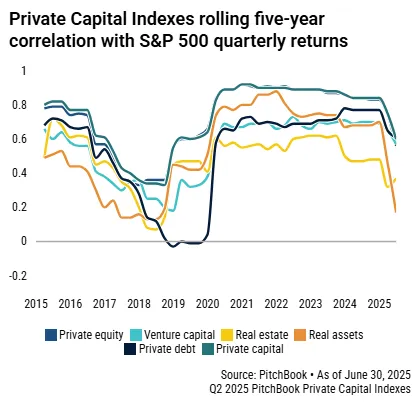
Source: Private Capital Indexes Q2 2025 - Pitchbook
Data from a UBS report also points out that this slower, more deliberate pricing helps smooth out short-term volatility. In a year when the S&P 500 can swing 20%–30%, private assets might only adjust a few percentage points because they’re tied to long-term fundamentals rather than daily trading activity.
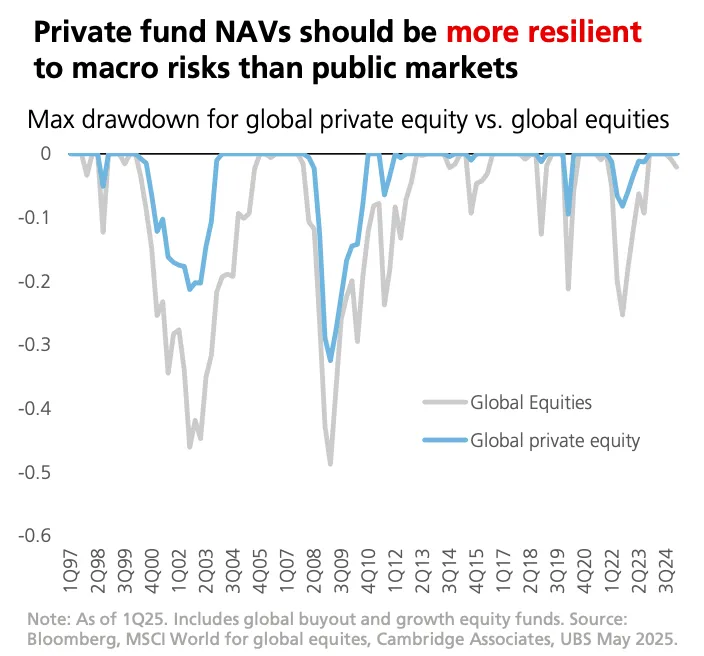
Source: Private Markets Outlook 2025 - UBS
This decoupling has direct consequences. Lower correlation makes private markets attractive for diversification, a portfolio that mixes public and private assets tends to be more stable. But it also means investors need to be more thoughtful about liquidity.
If public stocks drop overnight, private assets won’t adjust immediately, and it may take months for valuations to reflect broader economic conditions. So while private markets can feel more constant, they also require a longer attention span and more patience when capital comes back.
Deals take longer. Exits are slower. Continuation funds and secondary markets are growing. And the macro backdrop, from higher interest rates to geopolitical tension, affects private and public markets differently.
For founders, this change matters more than it might seem. Investors raising or deploying capital today are doing so in a world where private assets behave less like “slow public stocks” and more like a distinct asset class. They’re expecting longer holding periods, more measured valuation updates, and fewer quick exits.
That’s why recent due diligence processes might seem more focused on durability, a path to profitability, and clear milestones. And it’s also why late-stage investors can keep writing large checks, even when the public markets are unstable, because they’re evaluating companies on multi-year trajectories, not last week’s stock chart.
With companies staying private longer and correlations with public markets falling, liquidity has simply become harder to predict. That uncertainty is pushing founders and investors to explore alternatives earlier, which is why secondaries have grown into a mainstream part of fundraising conversations, often beginning as soon as the first institutional rounds are on the table.
The latest State of European Tech Report by Atomico shows just how much earlier these conversations now happen. A growing share of VCs proactively discuss exit or liquidity options during any fundraising process, sometimes as early as the Seed or Series A. Many revisit the topic regularly as the company grows.
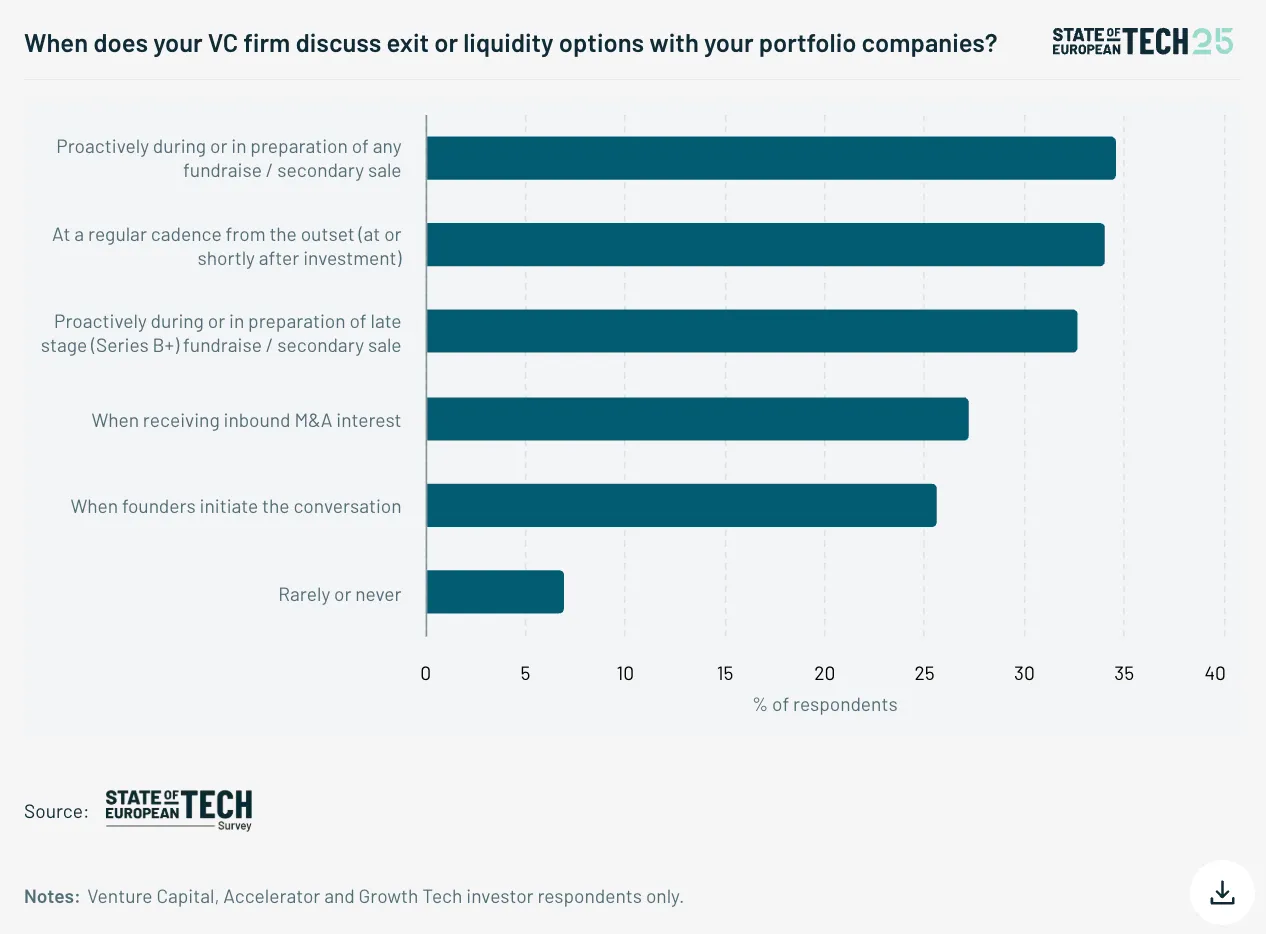
Source: State of European Tech by Atomico
Their behaviour shows us a change from past years when liquidity wasn't a topic until late-stage rounds or inbound M&A interest appeared. Today, secondaries are seen as both healthy and strategic: a way to give founders breathing room, help early employees realize some of the value they’ve created, and rebalance cap tables to prepare for later-stage growth.
The change fits neatly with the broader changes happening across private markets. When valuations adjust slowly and IPOs are pushed further out, secondaries act as a release valve, a way to keep talent motivated and investors aligned while acknowledging that liquidity timelines have stretched.
In markets where public-market volatility doesn’t immediately affect private-market pricing, secondaries also help reset expectations and match long-duration private assets with investors who have long-duration capital.
For founders, the rise of early and structured secondaries can be a real advantage. Liquidity can reduce personal pressure, make room for long-term planning, and improve alignment with your investors. It also allows earlier backers, angels, pre-seed funds, or accelerators, to recycle capital into new startups, strengthening the overall ecosystem. For new investors coming in at later stages, secondaries offer a way to build meaningful ownership without pushing the company to go public prematurely.
As private markets continue to evolve, founders and investors are navigating a landscape defined by longer timelines, slower valuation cycles, and more complex paths to liquidity.
Tools like secondaries, continuation vehicles, and structured liquidity programs are helping companies stay aligned and motivated throughout extended private lifecycles. That’s why it’s increasingly important to have a trusted, transparent platform that can support these liquidity needs.
SeedBlink Secondaries gives founders, employees, and early investors a structured way to access liquidity at the right time. For investors, it offers a chance to rebalance portfolios and gain exposure to high-quality companies that are still in their prime.
Written by

Patricia Borlovan
Communication Specialist
TABLE OF CONTENT

Subscribe to our newsletter
No spam. Just the latest releases and tips, interesting articles, and exclusive interviews in your inbox every week.
Share this article
The latest news, technologies, and resources from our team.